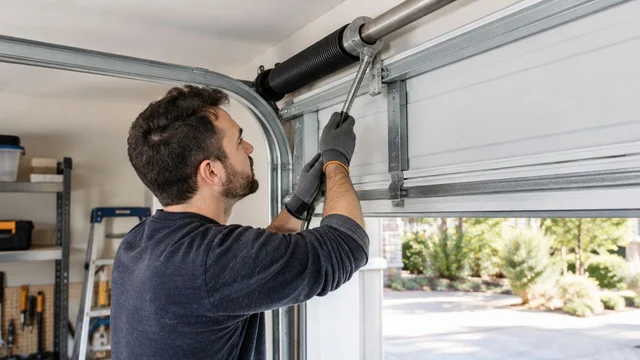
If your garage door reverses before closing in Richmond, KY, the opener is responding to a safety-sensor interruption, resistance in the door’s movement, or an incorrect closing-travel setting. Start with safe observations: note where the reversal happens and look for objects blocking the opening or sensor beam. Do not increase opener force, bypass the sensors, or force the door shut.
TL;DR
- When a garage door reverses before closing, check for beam obstructions and note exactly where movement stops.
- A reversal before floor contact differs from a door that closes completely and then reopens.
- Stop operating a crooked door or one with a loose cable, displaced roller, or damaged track.
- Derby Strong provides garage door repair and opener service; confirm Richmond availability when arranging an inspection.
Why does your garage door reverse before closing in Richmond, KY?
A reversing garage door needs diagnosis based on when it reverses and what the door does immediately beforehand. The symptom alone does not prove that the opener needs replacement. Sensor faults, mechanical resistance, and travel settings require different corrections.
The garage door sensors troubleshooting guide explains the sensor side of the problem. Its Lexington context does not change the need to follow your particular opener’s instructions.
| What you observe | What needs checking | Safe homeowner observation | Limit of that observation |
|---|---|---|---|
| Door starts down, then immediately reverses | Photoelectric sensors, beam obstruction, wiring | Look for objects across the beam and note indicator lights | Lights do not rule out every intermittent fault |
| Door reverses repeatedly at one position | Track, rollers, hinges, door movement | Record the position from a safe distance | Position alone cannot identify the damaged component |
| Door approaches the floor, then reverses without touching | Resistance, sensor interruption, closing travel | Note whether the door shakes or slows first | Do not change settings to test a guess |
| Door touches the floor and rises again | Closing travel, floor contact, door movement | Report that floor contact happened first | This is a different pattern from reversing before contact |
| Door tilts, jerks, or leaves one side lower | Cable, spring, roller, or track problem | Stop use and keep the opening clear | Professional inspection is required |
Why This Matters for Your Door
A reversal is a protective response, not permission to make the opener push harder. Defeating that response leaves the underlying problem unresolved and can create an entrapment hazard.
Derby Strong garage door repair is best suited to homeowners who need professional repair rather than high-tension DIY work. For a Richmond property, confirm service availability before booking; a company’s coverage elsewhere in Kentucky does not establish coverage at your address.
The practical goal is straightforward: separate a removable obstruction from an electrical or mechanical fault without creating another hazard. A clear description helps the technician investigate the right system instead of treating every reversal as an opener failure.
What should you check safely before calling?
Use this sequence for a residential garage door. Commercial overhead doors can have different controls and monitored safety devices, so do not apply residential troubleshooting instructions to a business door without its operating documentation.
Keep clear
Keep people, pets, vehicles, and stored items away from the opening. If the door is visibly crooked, hanging unevenly, or partly off its track, stop here. Do not walk underneath it to inspect the other side.
Do not pull the emergency-release handle on an open or damaged door as a diagnostic shortcut. A door with a spring or cable problem can move unexpectedly when disconnected from the opener.
Record position
Describe the reversal you already observed: immediately after starting down, halfway through travel, or near the floor. Note whether the bottom seal actually touched the floor.
One observed reversal is enough to begin a service report. You do not need repeated closing attempts to prove that the fault exists, especially if movement is rough or uneven.
Check obstruction
From outside the door’s travel path, look for a bin, tool, loose item, or debris interrupting the sensor beam. Inspect accessible sensor lenses visually; clean them gently only as directed by the opener’s manual.
Do not reach through a moving opening, loosen sensor brackets, or handle damaged wiring. Photograph an indicator light from a safe position rather than moving the sensor to see whether the light changes.
Report symptoms
Record the opener manufacturer and model from an accessible label or your paperwork. Include the indicator-light behavior, reversal position, unusual sound, and any recent impact or repair.
This sequence keeps your role observational. It does not include spring adjustment, cable handling, track straightening, or force-setting changes.
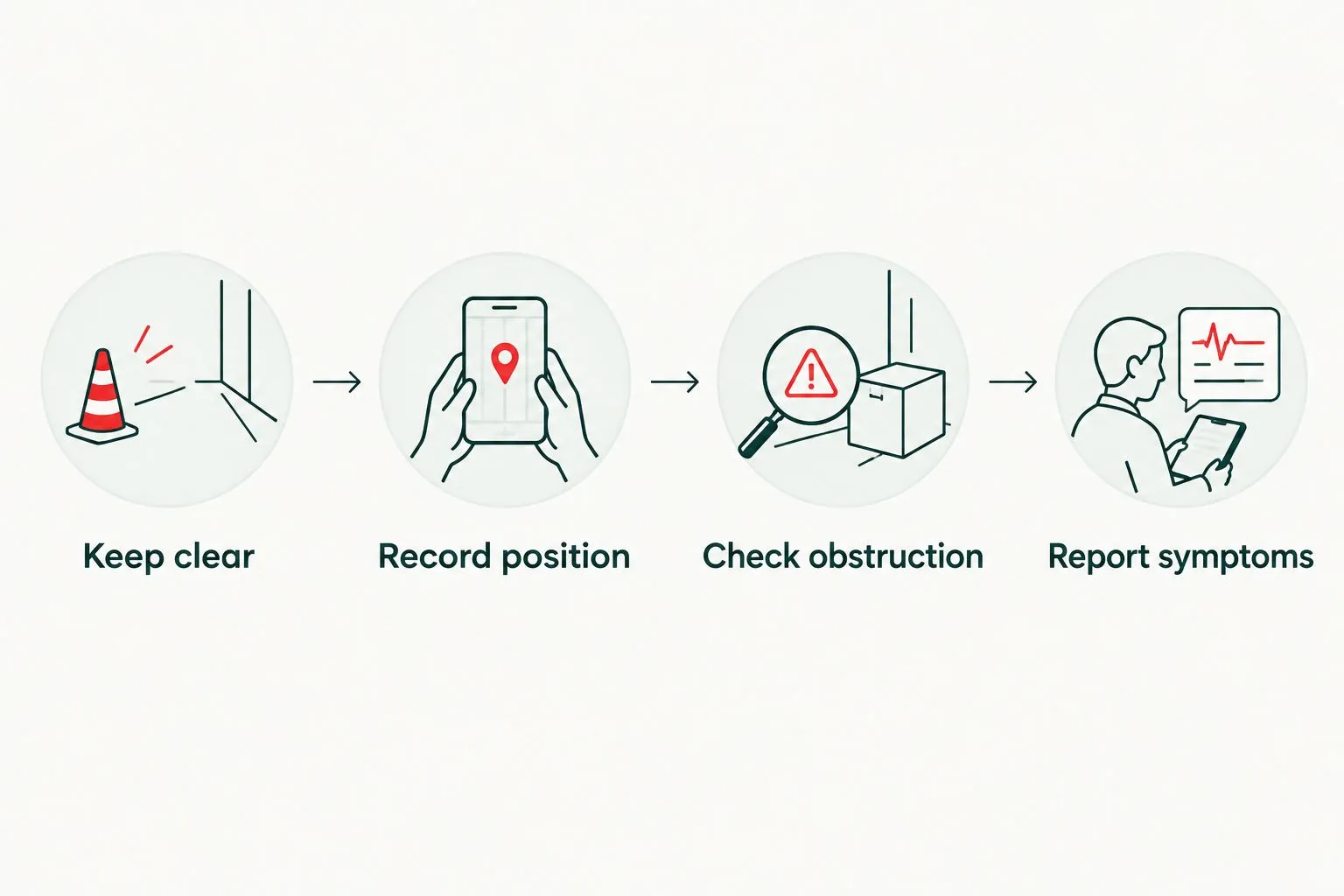
Illustrative diagram: observe the fault without adjusting the door’s high-tension components.
Could the safety sensors make the door reverse?
Yes. On an opener using photoelectric safety sensors, an interrupted or unreliable beam can prevent closing or cause reversal. A blocked beam does not mean the sensor itself has failed.
Look at the 2 opposing sensor faces near the lower sides of the opening. An object between them, dirt on a lens, a displaced bracket, or a wiring problem belongs in the diagnostic process. Direct sunlight can also interfere with some sensor installations; record a consistent time-of-day pattern rather than assuming sunlight is the cause.
Federal residential garage-door entrapment-protection requirements address photoelectric sensors installed no higher than 6 inches above the floor. That is a safety limit, not an instruction to relocate your sensors yourself. Follow the opener’s installation manual and have an incorrect installation assessed professionally.
Indicator colors and flash patterns differ by model. Use the exact manual rather than applying another opener’s light-code chart, and never interpret a steady light as proof that the entire door system is safe.
Could resistance in the door cause the same symptom?
Yes. An opener can reverse when it encounters resistance during closing. A damaged roller, track problem, binding hinge, door imbalance, or obstructed movement needs investigation before an opener setting is changed.
A rough spot at a repeatable height is useful evidence. So are scraping, a sharp change in sound, or one side moving differently from the other. None of these observations makes track or cable repair a homeowner task.
Stop operation when the door looks crooked, a cable hangs loose, or a roller is displaced. Do not straighten a track with a hammer, loosen a bottom bracket, or try to put a cable back on its drum. These components interact with the counterbalance system and can move under tension.
A technician should establish that the door moves correctly before deciding whether the opener’s closing travel needs correction. An opener adjustment cannot repair a damaged door.
Why the reversal pattern varies
The following factors explain why two doors with the same complaint can need different repairs:
- Beam interruption: An object can block the photoelectric path even when the main opening looks clear.
- Sensor stability: A displaced bracket, lens contamination, or electrical fault can interrupt reliable sensor operation.
- Mechanical resistance: Rollers, hinges, tracks, and door alignment affect movement through the opening.
- Counterbalance condition: A spring or cable problem changes how the door moves and requires professional attention.
- Closing travel: An incorrect endpoint requires model-specific evaluation after mechanical faults are ruled out.
- Floor contact: A door that touches down before reversing presents a different diagnostic pattern from one that reverses above the floor.
For your Richmond service report, describe the actual property condition rather than attributing the problem to Kentucky weather. A symptom that appears at a particular time or after a change is evidence to investigate, not a confirmed diagnosis.
Do you need opener repair or a replacement?
A garage door reversing before closing does not, by itself, justify a new opener. The decision depends on whether the fault lies in the door, the safety system, or the opener—and whether the existing equipment can be repaired and tested correctly.
| Approach | Best for | Benefit | Limitation |
|---|---|---|---|
| Correct an accessible obstruction | An item visibly blocking the sensor beam | Removes an identifiable cause without equipment replacement | Does not resolve damaged wiring or recurring faults |
| Repair the door mechanism | A confirmed roller, track, spring, or cable fault | Addresses resistance or unsafe movement at its source | Requires professional work on high-tension or damaged components |
| Repair the opener or safety system | A diagnosed, repairable equipment fault | Keeps functioning equipment in service | Depends on the fault, condition, and suitable replacement parts |
| Replace the opener | Equipment a technician determines needs replacement | Replaces the defective operating equipment | Does not correct a binding or damaged garage door |
When comparing garage door opener options, start with compatibility and safety requirements for the actual door—not a feature list detached from the diagnosed fault. A Colorado-focused comparison does not establish suitability for your Richmond installation; current manufacturer documentation must support the final choice.
Ask for the reason behind a replacement recommendation. The explanation should connect the failed component or equipment condition to the proposed work, rather than treating age or one reversal as sufficient evidence.
What should you tell a Richmond repair company?
Lead with the exact symptom: “The door starts closing, reverses before touching the floor, and stops back at the open position.” Change that description to match what actually happened. The difference between reversing above the floor and reopening after contact matters.
Give the company these details:
- Whether the door remains level or becomes crooked.
- Where travel stops, without guessing a measurement.
- Whether the sensor indicators stay steady or change.
- Any scraping, impact, loose cable, or displaced roller you can see safely.
- The opener model and any displayed diagnostic code.
- Whether the problem began after an impact, outage, or recent work.
When contacting Derby Strong about garage door repair, describe the closing fault and provide your Richmond address so availability can be confirmed. State whether the door is stuck open, closed, or between positions; do not promise yourself another closing attempt before the appointment.
Ask the technician to explain the cause, the proposed correction, and the safety checks required afterward. Successful movement once is not a substitute for checking the repaired system according to its manufacturer’s instructions.
Can you keep using a door that reverses?
Repeated unexplained reversal is a reason to stop routine operation until the cause is resolved. Do not use repeated button presses, a held wall control, or a force increase as a workaround for a safety fault.
If the door is open and cannot close safely, keep people away from the opening and secure the rest of the property without attaching anything to the door mechanism. Tell the service company that the opening is unsecured. Never attempt to lower an uneven or damaged door by hand.
If an obvious beam obstruction is removed and the door has no visible damage, follow the manufacturer’s operating and safety-check instructions. A recurring fault still needs diagnosis, even if an occasional attempt succeeds.
Frequently Asked Questions
Why does my garage door reverse before it reaches the floor?
A garage door can reverse before reaching the floor because of a safety-sensor interruption, mechanical resistance, or an incorrect closing-travel setting. Record the reversal position and stop using the door if movement is crooked, rough, or visibly damaged.
Can dirty garage door sensors cause reversal?
Dirty sensor lenses can interrupt reliable photoelectric sensor operation and prevent closing or cause reversal. Inspect accessible lenses safely and clean them only as directed by the opener’s manual; recurring trouble needs further diagnosis.
How high should garage door safety sensors be?
Residential photoelectric safety sensors must be installed no higher than 6 inches above the floor under federal entrapment-protection requirements. Follow the opener’s installation instructions and have an incorrect installation assessed professionally.
Should I increase the closing force if my door reverses?
Do not increase closing force to overcome an unexplained reversal. A technician should rule out obstructions, door damage, sensor faults, and mechanical resistance before making model-specific adjustments.
Why does my garage door reverse at the same spot?
A reversal at the same spot points the inspection toward a repeatable interruption or resistance during travel. Track, roller, hinge, sensor, and opener conditions still need diagnosis; the stopping position alone does not prove which part failed.
Does reversing mean I need a new garage door opener?
Reversing alone does not establish that you need a new opener. Repairing a sensor fault or door mechanism can address the cause without replacing functioning operating equipment.
Can I pull the emergency release when my garage door will not close?
Do not pull the emergency release on an open, uneven, or damaged door as a troubleshooting shortcut. A counterbalance fault can allow unexpected movement when the opener is disconnected; arrange professional assistance.
What should I report when booking garage door repair in Richmond, KY?
Report where the door reverses, whether it touches the floor, whether it stays level, and what the sensor indicators do. Provide your address and opener model, and confirm service availability before booking.
One Last Thing Before You Decide
The most useful detail is often whether the bottom seal touched the floor before the door rose. Record that fact once, from a safe position, and include it in your service request. For a 2026 repair decision, that observation is more useful than guessing which replacement part to buy.
Related Garage Door Guides
- Why a garage door closes and then reopens
- What a loose garage door cable means
- Garage door maintenance checklist
Local service: Garage door repair in Lexington