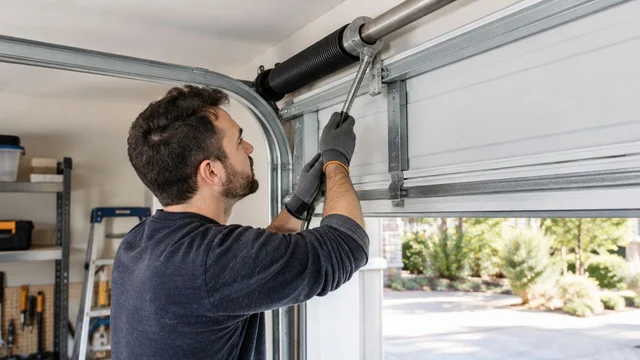
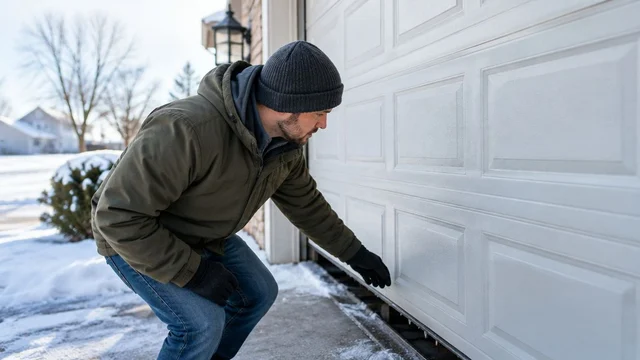
If your garage door will not close in Erlanger, stop cycling the opener, keep everyone clear of the opening, and check for visible obstructions or dirty safety-sensor lenses from outside the door’s path. A crooked door, loose cable, displaced roller, or damaged track means you should stop troubleshooting and arrange professional repair. Never bypass the sensors, increase opener force, or pull the emergency release on an open or damaged door.
TL;DR
- If your garage door will not close, clear visible obstructions without entering the door’s path.
- Clean accessible safety-sensor lenses gently; indicator-light meanings depend on the opener model.
- Stop operating a crooked door or one with loose cables, damaged tracks, or displaced rollers.
- Derby Strong provides garage door repair and opener service in Northern Kentucky; describe the symptoms before requesting service.
What should you do when a garage door will not close in Erlanger?
Separate a safe visual check from a repair that involves the door’s weight or tensioned hardware. You can look for an object across the opening and inspect accessible sensor lenses. You should not straighten tracks, move cables, adjust springs, or loosen brackets.
For service context, Derby Strong provides garage door repair and opener service in Northern Kentucky. When requesting help for an Erlanger property, describe what the door does rather than assuming the opener needs replacement.
- Keep the opening clear. Move children, pets, and bystanders away. Do not walk beneath a partially open door to inspect it.
- Look for obvious damage. From a safe position, check whether the bottom edge is level and the rollers appear seated in their tracks. A loose cable or tilted section ends the homeowner checks.
- Check the closing path. Look for bins, tools, leaves, or other objects interfering with the doorway or sensor beam. Remove an object only if you can reach it without getting beneath the door.
- Inspect accessible sensor lenses. With nobody operating the door, wipe dusty lenses gently with a soft cloth. Do not move brackets or disturb wiring.
- Follow the model’s instructions. If the door appears undamaged and you cleared a simple obstruction, use the manufacturer’s normal operating procedure while watching from a safe position. Stop if the fault remains.
Do not keep pressing the button to see whether the door eventually closes. Repeated attempts do not establish that the mechanism is safe.
Why This Matters for Your Door
A door that refuses to close is not automatically a failed opener. The opener might be responding correctly to a blocked safety beam, or the door might have a mechanical problem that makes further operation unsafe.
The useful distinction is what you can observe without moving or dismantling anything. That keeps a simple obstruction from becoming an unnecessary replacement decision and keeps a damaged door from becoming a do-it-yourself repair attempt.
For an Erlanger homeowner, the immediate problem also includes securing the opening. If you cannot close the door safely, restrict access from inside the property and explain that the garage remains open when you request service. Do not improvise a way to pull or prop the door into position.
What does the door’s behavior tell you?
Use the pattern below to describe the fault, not to diagnose a component conclusively. Several faults can produce similar symptoms, and indicator codes differ between opener models.
| What you observe | What needs checking | Safe next move | What the observation does not prove |
|---|---|---|---|
| Door does not start closing and an opener light flashes | Safety sensors, wiring, and the model-specific diagnostic code | Record the flash pattern and check accessible lenses | That the sensors need replacement |
| Door starts down, then reverses before reaching the floor | Beam interruption, binding, or another detected obstruction | Clear visible objects and stop if the problem continues | That increasing force is appropriate |
| Door reaches the floor, then rises | Closing travel, floor contact, and mechanical resistance | Note exactly when reversal occurs and request diagnosis | That travel adjustment alone will solve it |
| Door sits crooked or one cable looks loose | Door support, cables, rollers, and tracks | Stop operating it and keep people clear | That the opener caused the problem |
| Wall control operates the door but the remote does not | Remote battery, programming, and control settings | Consult the model’s control instructions | That the door mechanism needs replacement |
| Motor runs or hums without normal door movement | Opener connection, drive components, and door condition | Stop attempts and report the sound and movement | That replacing the motor is the correct repair |
Best for a homeowner check: an accessible obstruction or dirty lens, with no visible door damage. The advantage is that you can identify a simple interference without dismantling anything; the limitation is that a clear opening does not rule out wiring or mechanical faults.
Best for professional diagnosis: persistent reversal, abnormal noise, crooked movement, or visible hardware damage. Inspection can distinguish the door fault from the opener response, but you should leave the system unused until that assessment.
How do you check the safety sensors without bypassing them?
Start with objects rather than adjustments. A storage bin, broom handle, or hanging item can cross the beam even when the vehicle opening looks mostly clear. Check both sides of the doorway from a position outside the door’s travel path.
Look at the sensor lenses without moving their mounts. Dust or debris on a lens can interfere with its operation. Clean only what you can reach safely, and avoid tugging on the wiring.
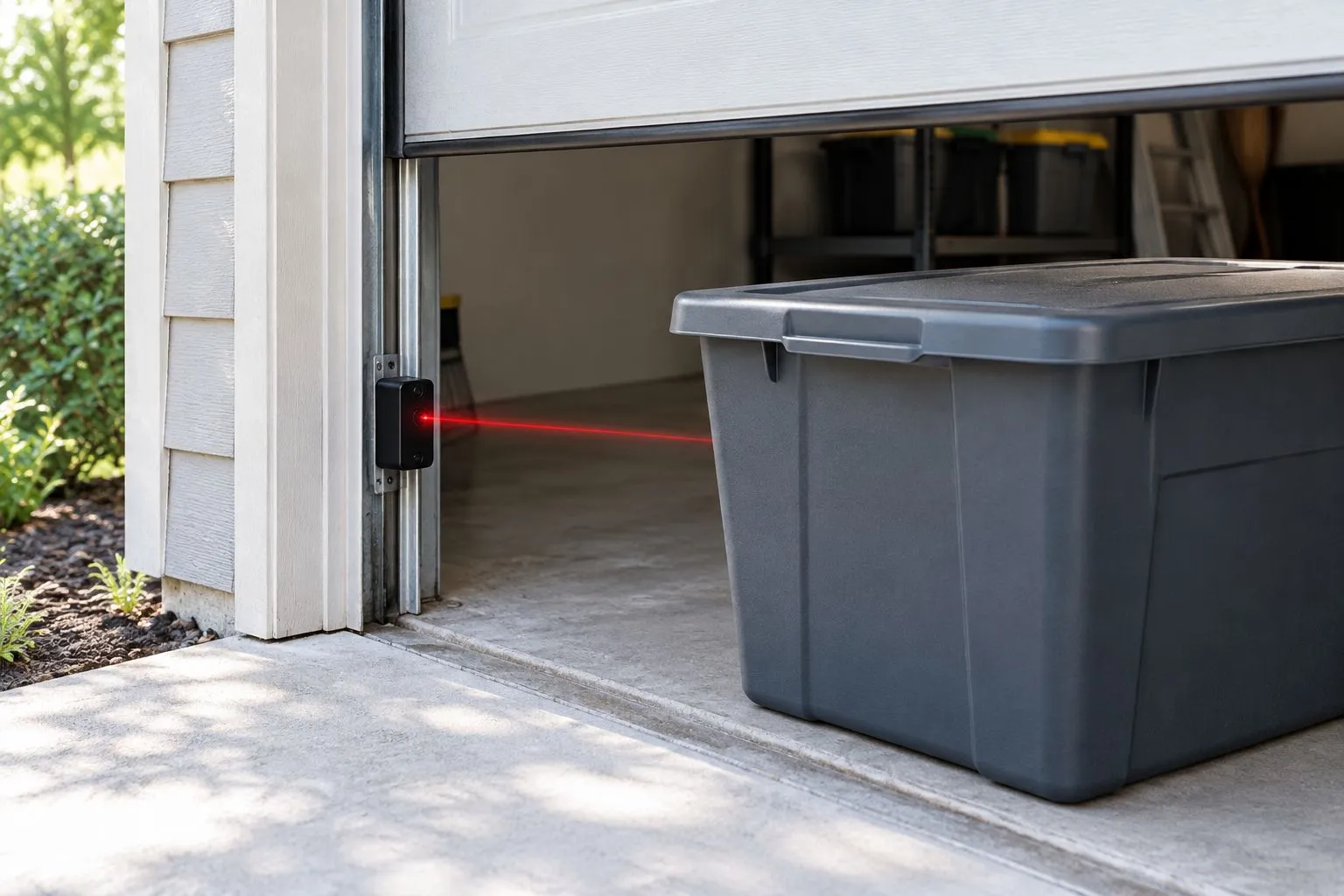
Illustrative image, not a Derby Strong project: stored objects can interrupt the sensor beam.
An illuminated sensor light is useful information, but it is not a universal pass-or-fail result. Some models use different colors or flashing patterns to identify power, alignment, or faults. Use the instructions for the exact opener rather than a generic color chart.
If a sensor is loose, its wiring is damaged, or the bracket appears bent, stop at observation. Do not tape sensors together, relocate them above the doorway, or use a bypass as a closing method. Removing an entrapment safeguard does not repair the underlying problem.
Which signs mean you should stop immediately?
Stop operating the door when its movement or support looks abnormal. The opener does not make an unstable door safe, and a door that is still attached to the opener can still have damaged hardware.
Keep clear and request professional service if you notice:
- A crooked bottom edge: one side hangs lower or moves differently from the other.
- A slack or displaced cable: a cable hangs loose, appears frayed, or is no longer following its normal route.
- A roller outside its track: the door is not properly guided.
- Bent or separated track: the track is visibly distorted or pulling away from its mounting.
- Damaged spring hardware: a visible spring gap, displaced component, or damage near a spring assembly.
- A sudden bang followed by abnormal movement: report the sequence without trying another operating cycle.
Springs, cables, bottom brackets, and associated hardware can carry substantial tension. Do not loosen fasteners, move a cable back onto a drum, or push a roller into position.
Derby Strong garage door repair is best for Northern Kentucky homeowners who need professional diagnosis of a door or opener fault. A description or photograph helps explain the problem, but it does not replace an inspection or establish the final repair.
Why does a garage door’s closing failure vary?
The stopping point and control response help narrow the inspection. They do not justify adjusting parts by trial and error.
- Beam obstruction: an object interrupts the safety sensors even though the opening looks clear from the driveway.
- Sensor condition: dirty lenses, disturbed mounting, or wiring faults affect the safety system.
- Mechanical resistance: damaged rollers, tracks, or door sections interfere with normal travel.
- Door support: spring or cable problems change how the door’s weight is supported.
- Opener travel settings: an incorrect stopping position affects how the opener handles the end of closing travel.
- Control faults: a remote, wall control, or associated setting prevents the expected command from reaching the opener.
This is why replacing a remote does not solve a crooked door, and changing opener settings does not repair a loose cable. Ask for the cause of the failure and the proposed correction to be explained separately.
Can you pull the emergency release to close the door manually?
Do not pull the emergency release on an open, partially open, crooked, or visibly damaged door. Disengaging the opener can remove a restraint from a door whose weight is not properly supported.
Manual operation is model-dependent and requires a mechanically sound door. For a door already stuck open with an unknown fault, leave disengagement and controlled closing to a technician rather than treating the release cord as a troubleshooting shortcut.
Should you hold the wall button until the door closes?
Do not use continuous button pressure as a workaround for a closing fault. Some residential openers have a manufacturer-defined constant-pressure function, but its presence and behavior depend on the model.
A door that behaves differently under continuous pressure still needs its safety system and mechanical condition checked. Do not instruct another person to hold the button while you stand in the opening or inspect the moving door.
Does a door that will not close need a new opener?
A closing failure alone does not establish that you need a new opener. An obstruction, sensor fault, damaged door component, or travel-setting issue requires a different correction from an internal opener failure.
Repair is appropriate when the identified fault can be corrected safely and the remaining equipment is suitable for continued use. Replacement decisions should follow diagnosis, parts compatibility, condition, and current manufacturer guidance—not the fact that the door refused to close once.
What should you tell the repair company before a visit?
Give the technician the property location in Erlanger and the door’s current position first. “Fully open and level” describes a different situation from “partly closed with one side lower.” Explain whether vehicles are trapped or the opening cannot be secured.
Then record the details you can obtain safely:
- Whether the door moves at all, reverses during travel, or reverses after touching the floor.
- Any flashing light or displayed diagnostic message, including the exact pattern.
- Whether the remote and wall control behave differently, if already observed.
- Any recent impact, power interruption, loud bang, or change in operating sound.
- Visible cable, roller, track, or panel damage photographed from outside the door’s path.
- The opener model, only if its label is readable without climbing or reaching near moving parts.
When you contact Derby Strong, provide those observations instead of requesting a specific replacement part. Do not reproduce dangerous movement just to make a video.
Before service, keep the approach clear without moving the damaged door. For a rental property, notify the owner or manager and follow the property’s repair-authorization process. Do not assume a shared or commercial overhead door uses residential troubleshooting procedures.
Frequently Asked Questions
Why will my garage door open but not close?
A blocked safety beam, sensor fault, mechanical resistance, or opener fault can prevent closing while opening still works. Check visible obstructions and accessible lenses, but stop if the door is crooked or hardware looks damaged.
What should I do if my Erlanger garage door is stuck halfway down?
Keep everyone clear and stop operating a garage door stuck halfway down. Do not pull the emergency release or try to push the door closed; report its position and any visible damage when requesting service.
Can sunlight stop garage door sensors from working?
Direct sunlight can interfere with some photoelectric safety sensors. Note whether the fault occurs at a particular time, consult the exact model’s instructions, and do not reposition or bypass the safety system.
Can I increase the opener force so the garage door closes?
Do not increase opener force to overcome a closing fault. Mechanical resistance, damaged hardware, or a safety-system problem needs diagnosis rather than additional force.
What does a blinking garage door opener light mean?
A blinking opener light is a model-specific signal, not a universal diagnosis. Record the pattern and compare it with the manufacturer’s instructions before assuming a sensor or motor needs replacement.
Is it safe to leave a garage door partly open until repair?
Treat a partially open, malfunctioning garage door as unsafe to approach or pass beneath. Keep people away, restrict access where possible, and explain the unsecured opening when requesting professional help.
Should I unplug the garage door opener to reset it?
A power reset does not correct damaged hardware, blocked sensors, or mechanical binding. Record diagnostic information first and follow the manufacturer’s instructions; do not reach an inaccessible plug or assume a reset makes the door safe.
One Last Thing Before You Decide
The point where the door stops is often more useful than the phrase “it will not close.” Write down whether it never moves, reverses during travel, or rises after reaching the floor. That observation gives the technician a clearer starting point without another risky test.
Related Garage Door Guides
- Garage door remotes, keypads, and apps in Erlanger
- Loose garage door cables in Northern Kentucky
- Garage door maintenance checklist
Local service: Garage door repair in Northern Kentucky