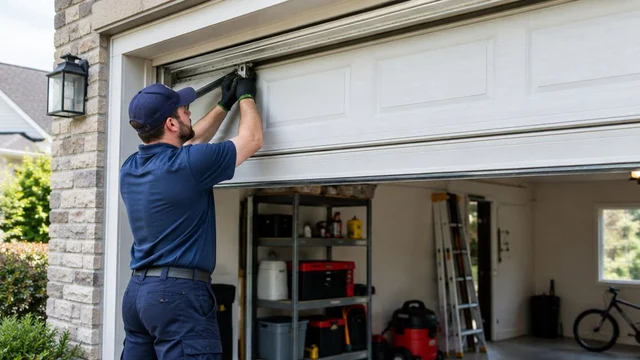
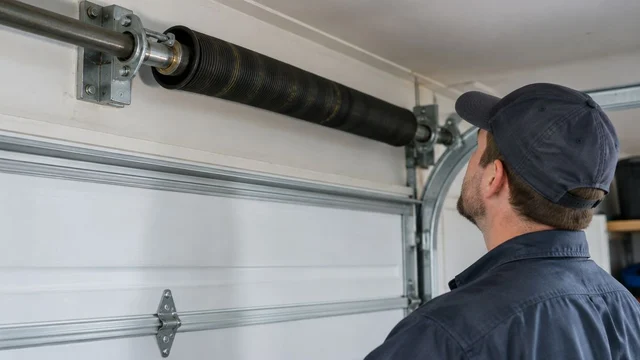
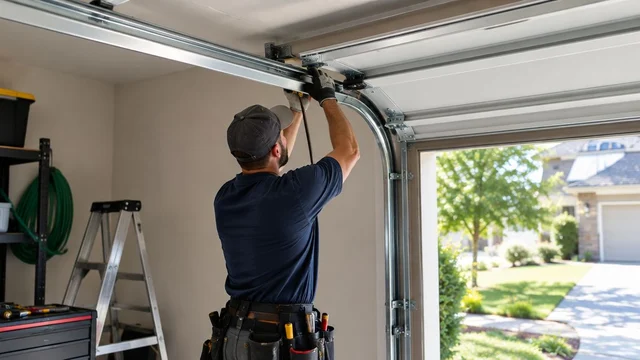
Your Lexington garage door needs a new cable when the existing cable has broken strands, fraying, kinks, substantial corrosion or a complete break. A loose cable or crooked door also requires professional inspection, but those symptoms can come from a spring, drum or track problem rather than cable damage alone; stop operating the door until the cause is identified.
TL;DR
- Garage door cable repair Lexington KY: fraying, broken strands and kinks require professional inspection and replacement of damaged cables.
- A loose cable does not prove the cable itself failed; springs, drums and door alignment also need inspection.
- Keep away from a crooked or partly open door, and do not pull the emergency release.
- Derby Strong provides garage door repair in Lexington; describe visible cable damage when requesting service.
How do you tell if a Lexington garage door needs a new cable?
Visible cable damage is stronger evidence for replacement than noise or opener trouble alone. Look only from a safe standing position outside the door’s travel path. Do not move the door to expose more of the cable.
For a door that is hanging unevenly, has a loose cable or shows broken strands, request a garage door inspection. Describe what you can see without touching the hardware.
| What you can see | What it means | Next move |
|---|---|---|
| Frayed wire or broken strands | The cable is damaged | Stop use; arrange professional replacement and inspection |
| A completely separated cable | The cable has failed | Keep everyone clear; do not operate the door |
| A sharp kink or crushed section | The cable has physical damage | Have the cable replaced and the cause checked |
| Heavy rust, pitting or flaking | Corrosion has damaged the cable surface | Have a technician assess replacement |
| A cable hanging loose or outside its drum grooves | Cable tension or routing is wrong | Stop use; inspect the spring and lifting system professionally |
| A crooked door without obvious cable damage | The door is not moving evenly | Treat it as a mechanical fault, not proof of cable failure |
A visual check cannot establish that a cable is safe throughout its length. Portions remain hidden or difficult to see, and the condition of the surrounding hardware matters.
Why This Matters for Your Door
The lifting cables work with the spring system to support and move a sectional garage door. A damaged cable can leave the door uneven, jammed or unsupported on one side. The opener does not make that condition safe.
Do not keep pressing the opener to see whether the problem clears. Repeated attempts can pull an already crooked door farther out of alignment and damage other components.
For a Lexington household, the immediate decision is whether to stop using the opening—not whether to order a replacement door. Cable damage alone does not establish that the entire door needs replacement.
What cable damage can you recognize without touching it?
Fraying and broken strands
Fraying looks like individual wires separating from the cable. You might notice loose wire ends, a ragged section or an uneven outline instead of a tightly wound cable.
Do not run your hand along it. Broken wires can cut skin, and touching a cable near loaded hardware puts you close to the lifting system. Report the location from a distance, such as near the bottom corner or near the drum.
Kinks, crushing and severe corrosion
A sharp bend, flattened area or crushed section is physical damage—not something to straighten by hand. A technician needs to determine why the cable was pinched, rubbed or wound incorrectly before installing a replacement.
Surface discoloration alone does not establish the cable’s remaining strength. Pitting, flaking and damaged strands are more concerning observations. Avoid scraping or bending the cable to investigate.
A complete break
A separated cable requires professional replacement. The inspection must also cover the opposite cable, springs, drums, bottom fixtures and door alignment.
Do not assume the other side will hold the door safely. Keep people, pets and vehicles away from the opening, especially if the door is suspended or tilted.
Does a loose cable always need replacement?
A loose cable needs professional diagnosis, but slack alone does not prove the cable is damaged. A broken spring, cable displacement, binding door or drum problem can affect cable tension.
That distinction matters because replacing a cable without addressing the cause leaves the underlying fault unresolved. Likewise, putting a visibly damaged cable back into position does not repair its broken strands or kinks.
Ask the technician to explain both findings separately: the cable’s condition and the reason it became loose. The repair should address both when both are defective.
Why the signs of cable trouble vary
Different faults can produce similar symptoms. These factors explain why a crooked door or slack cable needs more than a quick cable-only assessment:
- Cable condition: Broken strands, corrosion and deformation provide direct evidence of damage.
- Spring condition: A failed spring changes how the lifting system supports the door and can leave cables slack.
- Drum condition: Damaged grooves, displacement or an incorrect cable position can interfere with proper winding.
- Track and roller movement: Binding or displaced components can prevent the door from traveling evenly.
- Bottom attachment condition: Damage around the cable attachment affects how lifting force reaches the door.
- Door position: A closed door and a suspended, crooked door present different immediate safety concerns.
Do not use these factors as a repair checklist. Springs, drums, cable attachments and loaded brackets are professional-only work.
What should you do before the technician arrives?
You can collect useful information without testing, lifting or adjusting the door. Follow this sequence only where you can remain safely outside its travel path.
- Stop operation. Leave the remote, wall control and app alone. Tell everyone who uses the garage not to activate the door.
- Keep clear. Stay away from the opening, cables, tracks and bottom corners. Do not walk or drive beneath a partly open door.
- Record symptoms. Note whether the door is fully closed, tilted, partly open or stuck. Describe visible fraying or a hanging cable without approaching it.
- Arrange service. Explain the door’s position and whether the garage has another entrance. Mention any vehicle trapped inside.
A photograph from a safe location can help communicate the condition. Do not climb a ladder, lean into the opening or move the door to obtain a better picture.
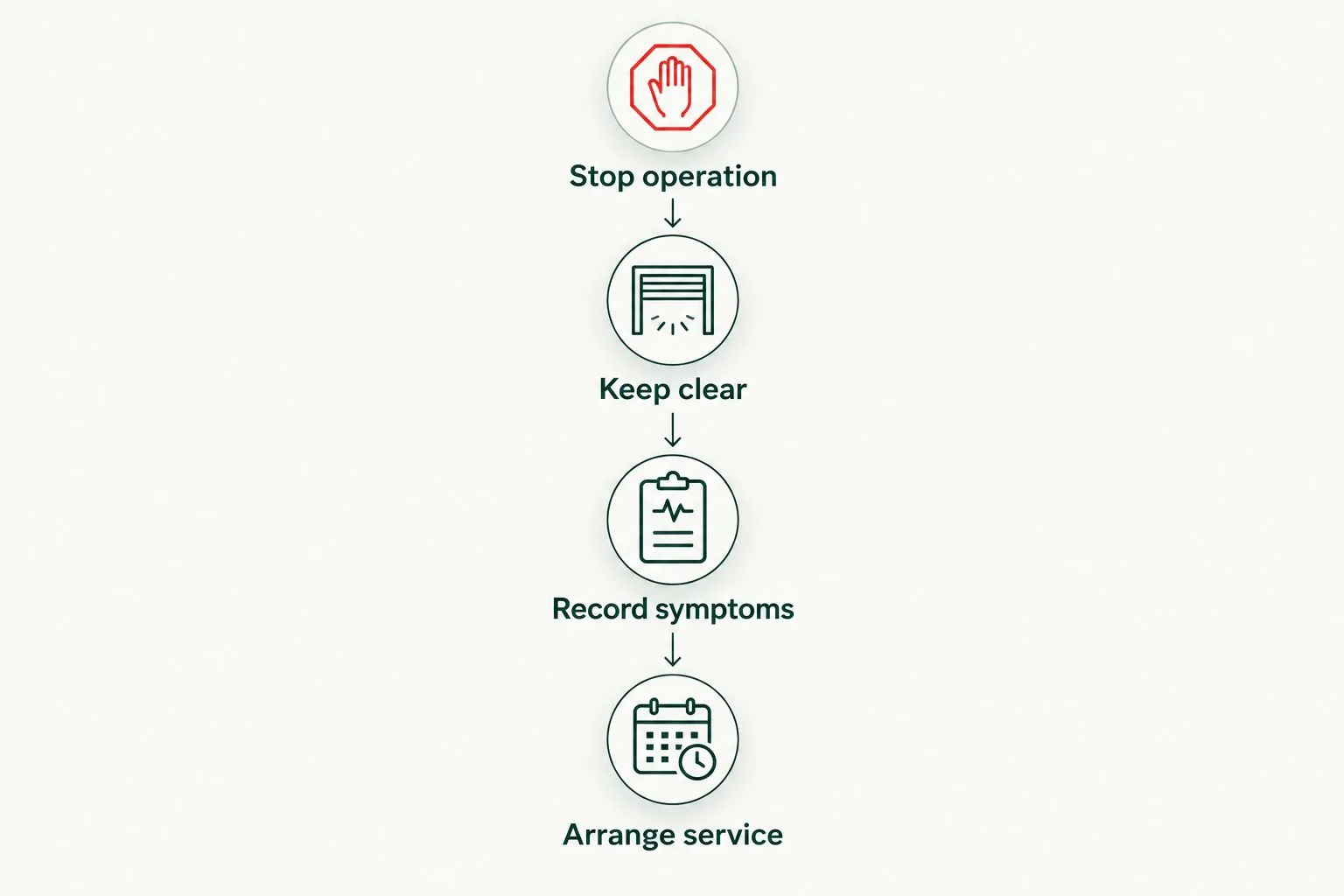
Prepare for service without moving the door or touching loaded hardware.
If the door is open, leave it in place and keep the area clear. Do not attempt to pull it down, prop it up, clamp it or release it from the opener. A technician must assess how to secure it.
How do you distinguish cable trouble from an opener or sensor fault?
A crooked door, loose cable or visible cable damage points toward a mechanical inspection. An opener that stops or reverses does not, by itself, identify a cable problem.
| Observation | More relevant inspection | Limit of the observation |
|---|---|---|
| Frayed cable beside the door | Cable and lifting-system inspection | Does not reveal every related fault |
| One side sits higher than the other | Cable, spring, drum and track inspection | Does not identify which component failed first |
| Door reverses with no visible cable damage | Obstruction, sensor and mechanical diagnosis | Reversal alone does not prove a sensor fault |
| Remote fails but no cable defect is visible | Control and opener diagnosis | Does not establish that the lifting system is healthy |
Do not run extra opening cycles to separate these possibilities. Report what already happened. A garage door that reverses also needs its safety devices and mechanical movement considered; changing opener force is not a safe workaround.
Does cable damage mean you need a new garage door?
A damaged cable does not automatically justify replacing the door. The choice depends on the condition of the panels, tracks, hardware and lifting system—not the cable symptom alone.
| Repair path | Best for | Benefit | Limitation |
|---|---|---|---|
| Cable replacement with a system inspection | A damaged cable on an otherwise serviceable door | Addresses the failed lifting component | Does not correct unrelated damaged hardware unless included |
| Cable repair plus related mechanical work | Cable damage alongside a spring, drum or track fault | Addresses the cable and its underlying cause | Requires a broader repair scope |
| Full door replacement | A door with damage or condition that makes repair unsuitable | Replaces the door assembly | Is unnecessary when a focused repair resolves the defect |
Ask for the findings behind a replacement recommendation. “The cable broke” explains a component failure; it does not explain why the panels or entire door must be discarded.
Derby Strong provides garage door repair for Lexington homeowners who need a damaged lifting system assessed. Ask what can be repaired, what needs replacement and what evidence supports each recommendation.
Should you replace both garage door cables?
Both cables should be inspected when either cable is damaged. The technician should consider their condition, compatibility and the door manufacturer’s requirements before defining the replacement scope.
Do not assume an apparently intact cable is healthy simply because the other one failed first. Conversely, ask for an explanation rather than accepting an unsupported claim that every surrounding component needs replacement.
If paired replacement is recommended, ask whether the opposite cable shows wear, whether matching components are required and whether a related fault affected both sides. Those answers make the proposed work easier to evaluate.
Can you open the door manually if a cable is damaged?
Do not manually operate a door with a broken, frayed or displaced lifting cable. Pulling the emergency release disconnects the opener; it does not restore cable support or correct an unbalanced door.
A door that looks fully closed still needs inspection before further use. Do not loosen the bottom bracket, detach a cable or try to lift one corner to level it.
If your vehicle is inside, tell the service provider before the visit. A trapped vehicle is inconvenient, but attempting to move an unstable door creates a separate hazard.
What should you tell a Lexington garage door repair provider?
Give the street address, the door’s current position and a plain description of the visible problem. If the property has several garage doors, identify the affected opening so nobody operates it by mistake.
Useful details include a cable hanging beside the track, visible broken wires, a tilted bottom edge or a loud sound immediately before the door stopped. Separate what you observed from what you suspect.
Ask whether the assessment will cover the cause of the failure as well as the replacement cable. A useful explanation connects the damaged component to the door’s overall operation without turning every cable problem into a new-door sales pitch.
Frequently Asked Questions
How can I tell whether my garage door cable is frayed?
A frayed garage door cable has individual wires separating from its tightly wound shape. Look from a safe distance; do not touch it or move the door to expose more cable.
Is a loose garage door cable the same as a broken cable?
A loose cable is not necessarily broken, but it signals a lifting-system problem that needs professional inspection. A spring fault, displacement or binding door can affect cable tension.
Can I still use my garage door if one cable breaks?
Do not use a garage door with a broken cable. Keep clear of the opening and do not rely on the remaining cable or opener to support it safely.
Does a crooked garage door always mean a cable broke?
A crooked garage door does not always mean a cable broke. Cable displacement, spring problems, track damage and other mechanical faults require inspection.
Can I put the garage door cable back on its drum myself?
Do not reposition a garage door cable yourself. The cable, drum, spring and bottom attachment are part of a loaded lifting system, and the cause of displacement must be identified.
Do I need a whole new garage door after a cable breaks?
A broken cable alone does not mean you need a new garage door. The decision depends on the condition of the door and related hardware and whether a focused repair restores safe operation.
Does Derby Strong provide garage door repair in Lexington?
Derby Strong provides garage door repair in Lexington. When requesting an inspection, describe visible cable damage and whether the door is closed, partly open or crooked.
One Last Thing Before You Decide
A new cable is not the complete repair if the reason it failed remains. Before approving the work, ask: “What damaged or displaced the cable, and how will this repair address that cause?” A clear answer is more useful than a cable-only diagnosis based on appearance.
Related Garage Door Guides
- Garage door cable replacement cost in Lexington
- Garage door rust repair in Lexington
- Garage door sensor troubleshooting in Lexington
- Garage door maintenance checklist
Local service: Garage door repair in Lexington