The cost to fix a garage door that will not close in Paris, KY, depends on whether the fault involves the safety sensors, opener, door hardware, or a physical obstruction; the symptom alone does not establish a reliable repair total. Ask whether the written estimate includes diagnosis, labor, parts, and a closing-safety check. Identify the failed component before approving an opener replacement or a new door.
TL;DR
- Garage door will not close repair cost in Paris, KY, depends on diagnosis, not the symptom alone.
- Check for visible obstructions without touching springs, cables, tracks, or brackets.
- Derby Strong provides garage door repair and opener service; confirm Paris address coverage before arranging a visit.
- Approve a repair scope that identifies the fault, included work, and closing-safety checks.
How much does it cost to fix a garage door that will not close in Paris, KY?
A useful estimate separates the inspection from the work needed to restore safe closing. A blocked sensor beam and a door hanging crooked require different responses, even though both leave the garage open.
Use the following breakdown to understand what a technician needs to diagnose—not to select a repair yourself.
| What you observe | What needs checking | What the estimate should explain |
|---|---|---|
| Door refuses to move downward | Sensor beam, sensor power, wiring, and opener diagnostics | Whether an obstruction, adjustment, wiring repair, or component replacement resolves the fault |
| Door starts down, then reverses before reaching the floor | Sensor interruption or resistance during travel | Which condition triggers reversal and how it will be corrected |
| Door reaches the floor, then reopens | Closing travel settings, resistance, and door movement | Whether adjustment alone is appropriate or a mechanical repair is necessary |
| Door looks tilted or has a loose cable | Cable system, springs, rollers, and tracks | How the door will be secured and which damaged components need attention |
| Motor runs but the door does not move | Opener connection, drive components, and door condition | Whether the fault belongs to the opener, the door, or both |
For more detail on one common diagnostic branch, read the guide to garage door sensors not working. The guide addresses Lexington readers, but the distinction between a sensor fault and a mechanical obstruction also matters when evaluating a Paris repair.
A symptom is not a parts list. An estimate that names a replacement component should explain the finding that supports it.
Why This Matters for Your Door
An open garage creates an immediate security problem, but urgency does not make every proposed repair necessary. Replacing the opener will not correct a bent track, and replacing the whole door is not the automatic answer to a sensor problem.
For a Paris homeowner comparing repair proposals in 2026, the useful comparison is the work included—not an advertised starting figure. Match diagnosis, parts, labor, and testing before deciding which proposal addresses the actual failure.
Sensor or obstruction problem: separate cleanup from repair
Best for: a door that remains straight, has no visible hardware damage, and refuses to close while something blocks the sensor path.
From outside the door’s travel path, look for a storage bin, broom, leaf buildup, or another object between the safety sensors near the floor. Remove only loose objects you can reach without stepping beneath a raised door or touching its hardware.
If the area is clear, note the sensor indicator lights and consult the exact opener manual. Indicator colors and flashing patterns differ by manufacturer and model; a light that looks normal on one unit does not establish that another unit is working correctly.
The advantage of a confirmed obstruction is that removing it addresses the cause without unnecessary replacement. The limitation is that a clear opening does not prove the sensors, wiring, or brackets are functioning correctly.
Ask the technician to distinguish between a blocked beam, a damaged wire, and a failed sensor. Those findings support different repair scopes. Do not bypass the sensors or treat an override method as a permanent solution.
Opener problem: confirm the door is not causing the fault
Best for: a door with a confirmed opener or control fault after the door’s mechanical condition has been checked.
An opener that hums, clicks, flashes, or reverses supplies diagnostic clues, not a complete diagnosis. Record what happens without repeatedly operating a door that binds, tilts, or makes a new grinding sound.
A targeted opener repair preserves a unit when the failed component can be repaired appropriately. Its limitation is that replacing an electronic or drive component does not resolve damaged door hardware or poor balance.
Before approving a new opener, ask what failed and why repair is unsuitable. If replacement is proposed, the estimate should identify the intended equipment and the work needed to connect, set up, and test it with the existing door.
Do not increase the opener’s closing force to overcome resistance. A stronger push is not a repair for a door that binds. Travel and force procedures belong to the specific manufacturer’s instructions and should follow correction of any mechanical fault.
Cable, spring, roller, or track problem: stop operating the door
Best for: professional diagnosis when the door is crooked, a cable hangs loose, a roller is displaced, or hardware appears damaged.
These symptoms change the decision from ordinary troubleshooting to securing the opening. Keep people and pets away, stop using the controls, and describe the visible condition when requesting service.
A component repair can preserve an otherwise serviceable door. Its limitation is that an obvious damaged part does not establish the full repair scope; the technician also needs to inspect connected components and identify why the failure occurred.
Do not loosen brackets, reposition cables, straighten tracks, or adjust springs. Do not pull the emergency release on a raised or unstable door: disconnecting the opener can allow an inadequately supported door to fall.
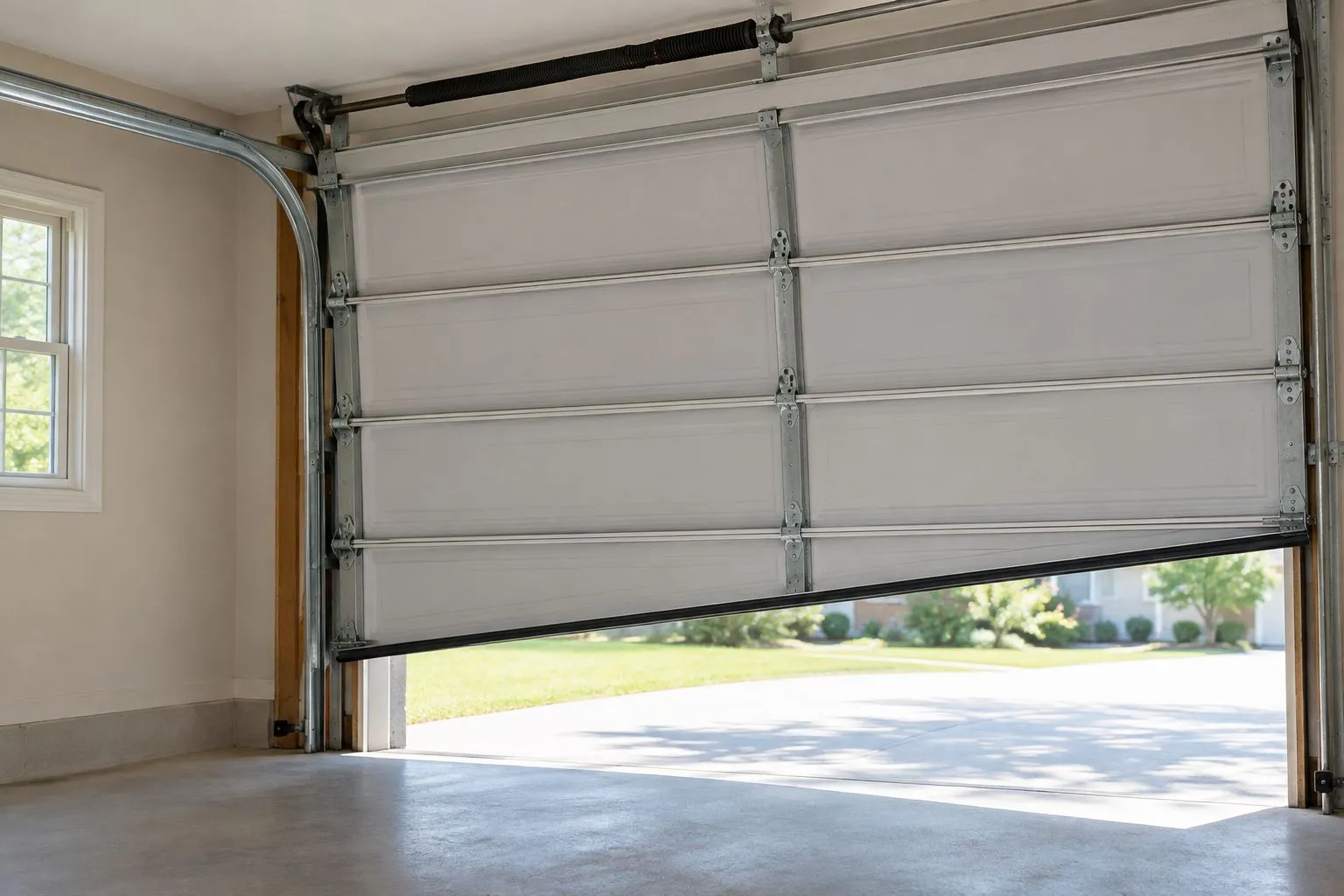
Illustrative photo, not a Derby Strong project: a tilted door calls for professional assessment, not another closing attempt.
Why garage door closing repair estimates vary
The repair scope changes with the confirmed fault and the condition of the connected system. Ask each company to explain these factors in plain language:
- Failure location: Sensor wiring, opener components, and door hardware require different work.
- Extent of damage: An isolated fault differs from damaged rollers, tracks, cables, and panels occurring together.
- Parts compatibility: The opener model and door hardware determine which replacement components are appropriate.
- Access conditions: Stored items or an unstable door can affect how the technician safely reaches the equipment.
- Included work: Diagnosis, removal of damaged components, installation, adjustment, and testing should be clearly identified.
- Visit terms: Ask whether the proposal includes the diagnostic visit and whether another visit would be necessary.
For your Paris property, provide the complete service address before accepting an appointment. A city name alone does not confirm that a particular company serves the address or that a quoted visit arrangement applies.
What can you safely check before requesting service?
Keep this check observational. You do not need to reproduce the failure repeatedly to give a technician useful information.
- Observe the door. From a safe position, note whether the bottom edge is level and whether any cable, roller, or panel looks displaced. Stop immediately if it does.
- Clear loose objects. If the door appears stable, remove accessible clutter outside its travel path. Stay out from beneath a raised door.
- Record the symptom. Note whether the door never starts down, reverses during travel, or reopens after touching the floor. Record indicator lights without interpreting them as a confirmed diagnosis.
- Prepare the details. Photograph the opener’s model label only if you can reach it safely, without climbing near the mechanism. Explain any recent impact, outage, or change in operation.
Tell the service company whether the garage is attached or detached, whether another entrance is available, and whether a vehicle is trapped. These details help explain the immediate problem without requiring you to move a damaged door.
What should the written repair estimate include?
A useful estimate lets you answer a simple question: What work will restore safe closing, and why is that work necessary? Ask for the diagnosis in ordinary language before agreeing to a parts list.
The proposal should distinguish required corrective work from optional maintenance or upgrades. If the technician recommends replacing several components, ask whether each is damaged, worn beyond serviceable condition, or part of a required matched assembly.
Look for these details:
- The observed fault and the affected component.
- The repair or replacement work proposed.
- Parts identification sufficient to understand what is being installed.
- Labor and diagnostic-visit terms.
- Any exclusions or conditions requiring further approval.
- The operational and safety checks included after repair.
Ask how additional findings will be handled before work begins. You should know whether the technician will stop and obtain approval if inspection reveals damage beyond the original scope.
For a closing fault, completion means more than watching the door reach the floor. Ask the technician to demonstrate normal operation and verify the applicable safety-reversal functions according to the opener manufacturer’s instructions.
Should you repair the fault or replace equipment?
Repair the confirmed fault when the existing equipment remains serviceable; consider replacement when inspection establishes a reason repair is unsuitable. A closing failure alone does not justify replacing the entire system.
| Approach | Best for | Main advantage | Main limitation |
|---|---|---|---|
| Targeted repair | An identified fault with serviceable surrounding equipment | Keeps usable equipment in place | Does not resolve unrelated wear or damage |
| Opener replacement | An opener fault that cannot be appropriately repaired | Replaces the failed operating equipment | Does not correct door balance, cable, or track problems |
| Door replacement | Damage or condition that makes door repair unsuitable | Addresses the door assembly rather than one symptom | Requires a broader installation scope and compatibility review |
If proposals disagree, ask each company to explain its diagnosis rather than simply matching the other’s parts list. A recommendation becomes more useful when it identifies what would remain unresolved under the alternative.
How do you arrange the right service for a Paris address?
Derby Strong garage door repair is best suited to homeowners seeking professional door or opener diagnosis rather than high-tension DIY work. The company lists garage door repair, installation, and opener service; confirm whether the specific Paris address is within its service area before arranging a visit.
Use the contact page to describe the closing failure, the door’s current position, and any visible damage. Do not assume a response time, appointment commitment, or visit term until it is confirmed.
Is a garage door that reverses always a sensor problem?
A garage door that reverses is not always experiencing a sensor fault. Resistance during travel, closing settings, and mechanical problems also require consideration; the point where reversal occurs helps guide inspection.
Can you leave the garage door open until it is repaired?
An open garage is not secure, and a visibly unstable door creates an additional safety concern. Keep the area clear, secure other entrances where possible, and tell the service company if the door is raised, crooked, or blocking your only practical exit.
Frequently Asked Questions
How much does it cost to repair a garage door that will not close in Paris, KY?
The repair total depends on the diagnosed fault and the work required to restore safe closing. Request a written estimate that explains diagnosis, labor, parts, visit terms, and final safety checks.
Can I fix a garage door that will not close by cleaning the sensors?
Removing an accessible obstruction or surface dirt can resolve a blocked sensor path, but it does not repair damaged wiring or failed components. Follow the opener manual and stop if the door is crooked or hardware looks damaged.
Why does my garage door close and immediately open again?
Reopening after reaching the floor requires checking closing travel, resistance, and door operation. Do not increase closing force to push through a fault.
Should I replace the opener if my garage door will not close?
Replace the opener only when diagnosis supports that decision. A new opener does not correct a bent track, damaged cable, or other mechanical door problem.
Is it safe to pull the emergency release when the door is stuck open?
Do not pull the emergency release on a raised or unstable door. Disconnecting the opener can allow a door with inadequate spring support to fall.
What should I tell the technician before a garage door repair visit?
Describe the door’s position, exactly when it stops or reverses, and any visible tilt, loose cable, or damaged panel. Provide the complete Paris address and ask the company to confirm service coverage and visit terms.
Does Derby Strong provide garage door repair at my Paris address?
Confirm the specific Paris address directly with Derby Strong before arranging service. Its stated markets include Louisville, Lexington, and Northern Kentucky; those market descriptions do not establish coverage for every surrounding address.
One Last Thing Before You Decide
Record when the door reverses, not just that it reverses. Refusing to start downward, stopping halfway, and reopening after touching the floor are different observations. Sharing that distinction helps the technician investigate the right part of the system without asking you to repeat an unsafe cycle.
Related Garage Door Guides
- Garage door closes, then reopens: a Florence troubleshooting guide
- Loose garage door cable safety in Northern Kentucky
- Garage door maintenance checklist
Local service: Garage door repair in Lexington