A fire rated roll up door is a listed rolling-door assembly designed to protect an opening against fire for its labeled rating. Your building needs an approved fire-door assembly where the applicable code and approved plans require opening protection—not simply because the building has a warehouse, shop or loading bay. A rolling door is one possible assembly; the required rating, closing operation and any smoke-control features must match that specific opening.
TL;DR
- A fire rated roll up door protects a required opening; an ordinary steel rolling door does not replace it.
- NFPA 80 addresses fire-door installation, inspection, testing and maintenance; approved plans determine the opening’s requirements.
- A fire rating does not automatically establish smoke-leakage protection or permission to use the opening for egress.
- Derby Strong provides commercial overhead-door service; confirm fire-door-specific scope before scheduling regulated work.
Why This Matters for Your Door
Buying a steel door is not the same as buying a listed fire-door assembly. Two curtains can look similar while serving different purposes. Substituting an ordinary rolling door at a protected opening can remove a required part of the building’s fire protection.
For a Louisville business owner, start with the approved building plans and the authority having jurisdiction—the building or fire official responsible for the requirement. Do not order a replacement based only on the existing opening’s dimensions.
Routine commercial overhead-door maintenance and fire-door inspection address related but different responsibilities. A door that opens smoothly during deliveries still needs its required fire-protection functions checked.
What is a fire-rated rolling door, and when does a building need one?
A building needs a fire-door assembly when an opening must be protected under its applicable building and fire requirements. That determination depends on the wall or separation, the opening’s location, the building’s use and approved design—not the owner’s preference for a particular door style.
Use this sequence before choosing equipment:
- Find the opening on the plans. Check the life-safety drawings, wall information and door schedule. Identify whether the opening requires fire protection.
- Confirm the opening-protection requirement. Ask the design professional or responsible official to identify the required door rating and any additional conditions.
- Check whether a rolling assembly fits. Verify that its listing permits the opening size, wall construction, mounting arrangement and intended operation.
- Coordinate closing and controls. Establish how the assembly closes during a fire condition and how any detection, release or alarm interfaces must work.
- Arrange acceptance and ongoing care. Confirm the required inspection, testing, documentation and maintenance before putting the opening into regular use.
A rated wall does not give you enough information to select the door by itself. The required opening-protective rating is not automatically identical to the wall’s fire-resistance rating. Have the requirement identified rather than guessing from a wall label.
A new tenant, altered layout or changed building use also warrants a review. An opening that worked for the previous operation is not proof that the same arrangement suits the new one.
How does a fire-rated rolling door compare with other overhead doors?
| Door assembly | Best for | Main benefit | Main limitation |
|---|---|---|---|
| Ordinary rolling steel door | Security and routine operation where fire protection is not required | Closes a working commercial opening | Does not provide a fire rating merely because it is steel |
| Listed fire-rated rolling door | Openings requiring compatible rolling fire protection | Provides the fire protection established by its listing | Requires the specified assembly, closing functions, inspection and testing |
| Fire-rated rolling door with applicable smoke-leakage listing | Openings requiring both fire protection and specified smoke-leakage performance | Addresses separate fire and smoke requirements when properly specified | A fire label alone does not establish smoke-leakage performance |
None of these is a universal upgrade over the others. Choose the assembly the opening requires, then select operating features that fit the business.
What a fire-door rating does—and does not—tell you
A fire rating describes performance under a standardized test. It is not a promise that a door will remain safe to touch, stop every combustion product or provide the same protection under every real fire condition.
The listing applies to an assembly, not just the visible curtain. Guides, brackets, mounting details, closing equipment and other specified components affect whether the installation matches that listing. A replacement part that looks similar is not automatically an acceptable substitute.
Fire protection is different from smoke protection
Fire resistance and smoke leakage are separate questions. Where smoke-leakage performance is required, the assembly needs the applicable listing and installation details; adding a generic seal does not establish compliance.
Do not describe a fire-rated door as smoke-tight without supporting documentation. Ask which specific smoke requirement applies and how the proposed assembly meets it.
A fire door is not automatically an exit
A large opening does not automatically qualify as a required means of egress. Rolling-door operation, occupant escape and fire separation must be evaluated together under the applicable requirements.
Keep designated exits available independently of your assumption that an overhead door will open. Ask the design professional to resolve any conflict between the door’s closing function and the building’s evacuation arrangements.
Why fire-rated rolling-door requirements vary
The same-looking opening can require a different assembly in another part of the building. These factors drive the specification:
- Wall function: The opening’s protection depends on the particular fire-resistance-rated separation and applicable opening rules.
- Building use: Occupancy and the activities on each side of the opening affect the design review.
- Opening dimensions: The proposed assembly must stay within its listed size and installation limits.
- Supporting construction: Wall materials, structural support and attachment details must suit the listed installation.
- Closing arrangement: The release method, operating equipment and any alarm connections must work together as required.
- Smoke and egress requirements: These can add conditions that a basic fire rating does not address.
For a Louisville project, put these questions to the responsible official before fabrication or structural changes. A door supplier’s dimensional drawing does not replace approval of the building’s fire-protection design.
What should you check on an existing rolling fire door?
Start with observations you can make from a safe position. Do not remove covers, climb to the barrel or operate a release mechanism to investigate a concern.
Read the label. Photograph accessible identification labels without disturbing them. Record the manufacturer, model or identifying information, and the stated rating where legible. A missing or unreadable label needs professional evaluation; appearance cannot establish the rating.
Keep the opening clear. Look for stored goods, shelving, carts or equipment in the closing path. Include the full width of the opening and the area where the bottom bar meets the floor.
Report visible damage. Note bent guides, damaged curtain slats, loose-looking supports or impact marks. Do not straighten parts, tighten structural attachments or keep cycling a visibly damaged door.
Find the records. Gather previous inspection reports, test documentation, repair history and installation information. Tell the service provider about changes to the opening or controls.
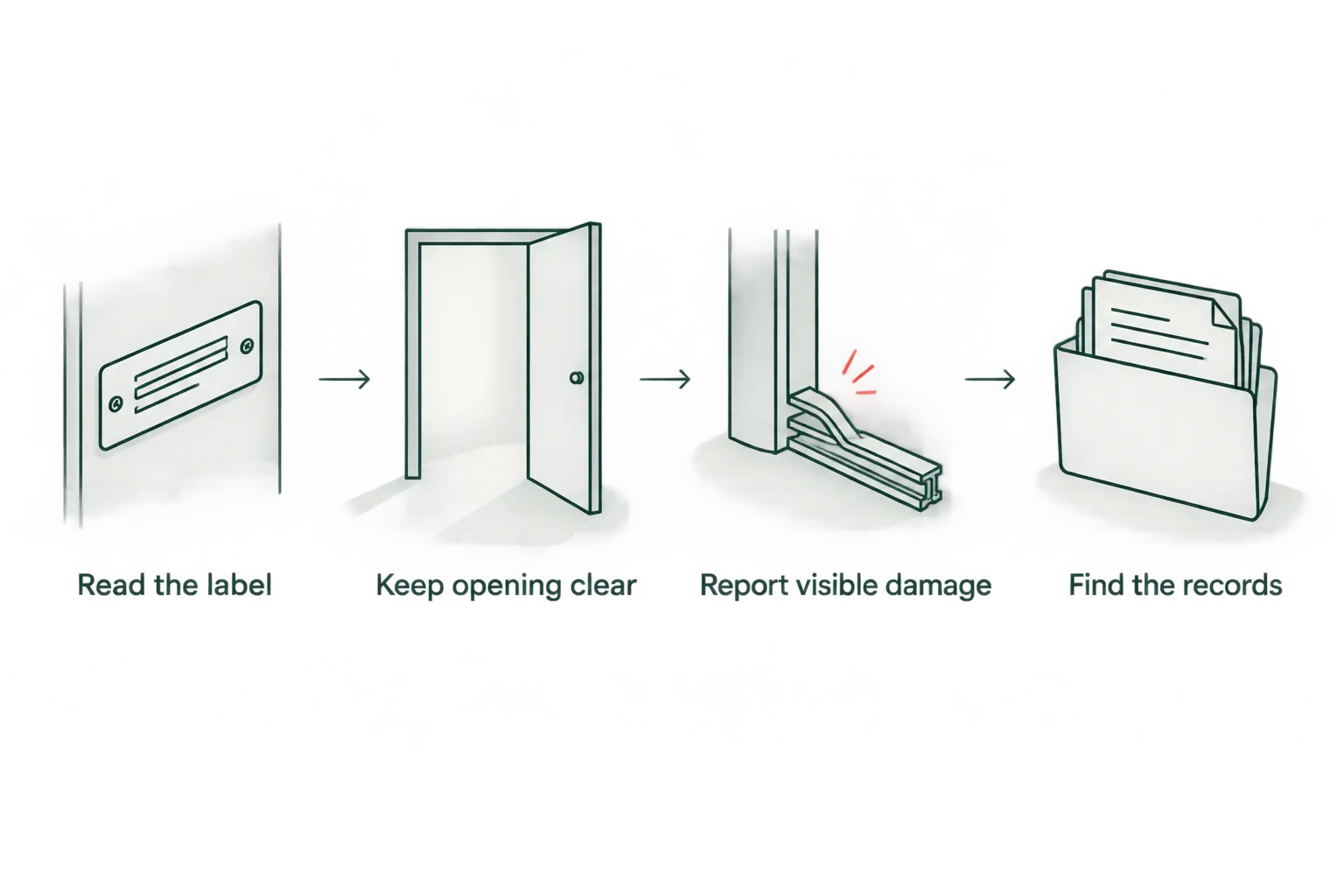
Observe and document concerns; leave release testing and repairs to qualified personnel.
These checks prepare you for service. They do not prove that the assembly will close correctly during a fire condition or replace a required inspection.
How often does a rolling fire door need inspection and testing?
NFPA 80 calls for fire-door assemblies to be inspected and tested at least annually. Rolling steel fire doors also require the applicable operational and drop testing under that standard. Confirm the adopted requirements and manufacturer’s instructions for your installation.
NFPA 80, Standard for Fire Doors and Other Opening Protectives, addresses installation, inspection, testing and maintenance. UL 10B, Fire Tests of Door Assemblies, addresses fire-test performance; UL 1784, Air Leakage Tests of Door Assemblies and Other Opening Protectives, addresses air leakage. These references serve different purposes and do not independently determine what your building needs.
Use personnel qualified for the work and familiar with the assembly. A drop test is not an owner troubleshooting step. Do not pull release hardware, cut a fusible link, bypass a control or stand beneath a descending door to test it yourself.
Keep the inspection and test records with the building’s maintenance documents. If a report identifies a deficiency, arrange correction and any required follow-up testing rather than treating the report as proof that the door passed.
Can you repair a rolling fire door instead of replacing it?
Repair is appropriate when the assembly can be restored using acceptable parts and procedures while maintaining its listing. A damaged component does not automatically justify replacing the entire door. Equally, a working motor does not establish that the fire-protection functions remain acceptable.
Ask the service provider to separate the findings into mechanical defects, closing or release problems, identification issues and installation concerns. That distinction helps you understand whether the proposed repair addresses the actual deficiency.
Replacement needs closer consideration when the assembly cannot be verified, acceptable parts cannot be identified, or alterations prevent restoration to the listed arrangement. Have those conditions evaluated rather than approving an improvised repair.
Derby Strong provides commercial overhead-door service for Louisville businesses. Derby Strong is an option for Louisville owners seeking commercial overhead-door service, not a substitute for code approval. Before booking fire-door work, confirm that the requested inspection, repair or testing is within the provider’s accepted scope.
What should you send before requesting service?
Give the provider enough information to identify the job without asking staff to dismantle anything. Send accessible label photographs, a wide view of the opening, the latest inspection report and a plain description of the problem.
Explain whether the door is stuck, damaged, failing a documented test or being considered for replacement. Include any known alarm connections and recent alterations, but leave technical conclusions to the responsible professionals.
When contacting Derby Strong, identify the equipment as a rolling fire door rather than a standard overhead door. Ask who will handle any required alarm coordination, acceptance testing and documentation so those responsibilities are clear before work begins.
Frequently Asked Questions
Does every commercial building need a fire rated roll up door?
No. A building needs an approved opening-protective assembly where its applicable code and approved design require one. A rolling fire door is one possible solution, not a universal requirement for commercial buildings.
Is a steel roll-up door automatically fire rated?
No. Steel construction alone does not establish a fire rating. Verify the assembly’s identification, listing and installation rather than judging by its appearance.
Can I replace a rolling fire door with a regular overhead door?
Not while the opening still requires fire protection. Any change to that requirement needs approval through the responsible building or fire authority; an ordinary replacement is not equivalent.
Does a fire-rated rolling door stop smoke?
A fire rating alone does not establish smoke-leakage performance. Where smoke protection is required, verify the applicable listing and installation requirements for that purpose.
Can employees perform a rolling fire-door drop test?
Do not assign a drop test as routine employee troubleshooting. Use personnel qualified for the assembly and required test, and keep people clear of the closing path.
How often should a rolling fire door be inspected?
NFPA 80 calls for inspection and testing at least annually. Confirm the applicable adopted requirements, manufacturer’s instructions and any additional conditions for your installation.
What should I do if a rolling fire door is damaged or will not close?
Report the impairment promptly and keep people away from the damaged door. Follow the building’s fire-safety procedures, notify the responsible facility contact and arrange qualified evaluation without forcing or bypassing the assembly.
One Last Thing Before You Decide
A replacement opener can affect more than everyday convenience. On a rolling fire door, operating equipment and release arrangements must remain compatible with the listed assembly and required closing sequence.
Before approving a motor, controller or alarm-interface change, ask how the change affects fire closing and what testing follows the work. Treat an equipment upgrade as a fire-door coordination question—not simply a way to make the door move again.
Related Garage Door Guides
- Overhead doors for school facilities
- Commercial overhead-door options for Kentucky warehouses
- Overhead doors for manufacturing plants
Local service: Garage door repair in Louisville · Garage door repair in Lexington · Garage door repair in Northern Kentucky