Best overall for a heated farm workshop: an insulated steel sectional overhead door. Best for unheated equipment storage: an uninsulated steel sectional door. Best where ceiling space must stay clear: a rolling steel overhead door. For Kentucky agricultural buildings, choose by building use, equipment clearance and structural fit—not appearance alone.
TL;DR
- Insulated sectional overhead doors are the default choice for heated Kentucky farm workshops.
- Uninsulated sectional doors suit unheated equipment storage when overhead tracks fit the building.
- Rolling steel doors keep horizontal tracks out of the ceiling area but need mounting space above the opening.
- Derby Strong provides commercial overhead door services; confirm the building requirements before selecting a door.
Why This Matters for Your Door
A farm door must clear the equipment, fit the building and operate safely around people. A door that looks large enough on a drawing can still interfere with a raised attachment, interior beam or overhead light.
Derby Strong provides commercial overhead door services for businesses in Louisville, Lexington and Northern Kentucky. For an agricultural building, start the discussion with the actual opening and intended use rather than a residential door style.
An insulated sectional door is the strongest starting point for a heated workshop, not an automatic upgrade for every barn. Unheated storage and buildings with crowded ceilings need different answers.
What makes the best overhead doors for farm buildings?
Use these criteria before comparing door types:
- Clear opening: The usable passage must accommodate the widest and tallest equipment in its travel position, with appropriate clearance.
- Building fit: The header, jambs and mounting structure must support the specified door system. Metal siding alone does not establish adequate support.
- Thermal performance: Heated spaces need attention to the complete door assembly, perimeter seals and installation—not insulation claims alone.
- Operating demand: The door, springs and operator must suit the expected opening frequency and actual door specifications.
- Exposure and upkeep: Select finishes, seals and components for the conditions at the opening, including moisture and agricultural contaminants.
- Safe operation: Controls, entrapment protection and pedestrian routes must match the application and current installation requirements.
Farm overhead doors at a glance
These are door categories, not manufacturer or model endorsements. Each has a different job, and final suitability depends on the specific product documentation and site inspection.
| Door type | Best for | Standout feature | Key limitation |
|---|---|---|---|
| Insulated steel sectional | Heated repair workshops | Insulated sections with several track-layout possibilities | Tracks and the open door occupy interior overhead space |
| Uninsulated steel sectional | Unheated equipment storage | Sectional operation without an insulation-focused specification | Limited thermal separation for a conditioned space |
| Rolling steel overhead | Buildings needing a clear ceiling area | Curtain coils above the opening rather than resting on horizontal tracks | Coil, guides and mounting structure need their own clearance |
1. Insulated steel sectional: best for heated farm workshops
An insulated sectional overhead door uses hinged sections that travel along tracks. It is the default recommendation when you heat a farm repair bay and regularly work inside with the door closed.
The advantage is thermal separation, but the specification matters. A quoted panel insulation value does not describe every heat-loss path through the installed opening; joints, edges, glazing and seals also matter.
Insulated steel sectional pros:
- Supports the thermal needs of a heated work area.
- Offers track configurations that can be evaluated against the building layout.
- Allows the installer to assess individual sections and associated hardware when diagnosing damage.
Insulated steel sectional cons:
- Requires space for tracks, hardware and the door in its open position.
- Does not correct air leakage elsewhere in the building.
- Needs finish and hardware selection appropriate to the actual exposure.
Best for: A heated agricultural workshop used for equipment repairs, maintenance or other indoor work.
Ask for the thermal information available for the complete assembly and an explanation of the perimeter sealing. Do not choose solely by the largest insulation number in a brochure. Confirm that the proposed operator and track arrangement suit the selected door.
Verdict: Buy for a heated workshop once clearance, mounting and exposure requirements are confirmed.
2. Uninsulated steel sectional: best for unheated equipment storage
An uninsulated steel sectional door uses the same general hinged-section movement without an insulated panel construction. It fits a different brief: enclosing an unheated storage building where thermal separation is not the main objective.
Keep the decision tied to the building. If you intend to add heat later, compare the door specification with that future use before ordering.
Uninsulated steel sectional pros:
- Matches storage applications that do not need an insulated enclosure.
- Provides a sectional option where the structure accommodates tracks.
- Keeps attention on essential requirements such as clearance, mounting and safe operation.
Uninsulated steel sectional cons:
- Provides limited thermal separation for a heated workspace.
- Still occupies overhead space when open.
- Does not solve moisture or condensation problems through door selection alone.
Best for: Unheated machinery storage with adequate interior track clearance.
Ask the installer to explain the specified panel construction, reinforcement and finish. “Uninsulated” describes thermal construction; it does not establish that the door is suitable for the opening size, exposure or operating demand.
Verdict: Buy for genuinely unheated storage; hold if conversion to a heated shop is already planned.
3. Rolling steel overhead: best for keeping ceiling space clear
A rolling steel overhead door has a curtain that coils above the opening. Unlike a conventional sectional door, it does not leave the open door supported on horizontal tracks extending into the building.
That arrangement deserves consideration when beams, lighting or other equipment conflict with a sectional layout. It still needs adequate headroom, side clearance and supporting structure.
Rolling steel overhead pros:
- Keeps horizontal sectional tracks out of the interior ceiling area.
- Stores the curtain above the opening.
- Provides an alternative when a sectional track layout conflicts with building use.
Rolling steel overhead cons:
- Requires room for the coil, guides and operating equipment.
- Needs a suitable mounting structure rather than an assumption that the existing opening will work.
- Requires product-specific evaluation of insulation, sealing and environmental suitability.
Best for: An agricultural building where interior overhead obstructions rule out a practical sectional arrangement.
Do not confuse a rolling steel curtain with a sectional door using high-lift tracks. They move and store differently. Have the installer compare both layouts when the ceiling area is the deciding constraint.
Verdict: Buy when preserving ceiling space is necessary and the opening supports the specified rolling system.
Check equipment clearance before choosing a door
Measure the equipment as it actually passes through the opening. Mirrors, cabs, exhausts and attachments can determine clearance even when the main body fits comfortably.
Record the clear width and height at the narrowest points. Then document the approach: a machine entering at an angle needs a different assessment from one moving straight through a level opening.
Use this checklist when preparing for an inspection:
- Equipment envelope: Record the widest and tallest travel configuration, including attachments that remain fitted.
- Opening dimensions: Distinguish the framed opening from the unobstructed passage after installation.
- Interior obstructions: Photograph beams, lights, ducts, shelves and anything near the proposed tracks or coil.
- Approach conditions: Show slopes, thresholds and turning constraints that affect entry.
- Future equipment: Identify planned machinery changes before the opening becomes a fixed constraint.
For measurement terminology, the guide to measuring a garage door opening in Lexington provides related background. A commercial agricultural opening still needs its own professional assessment.
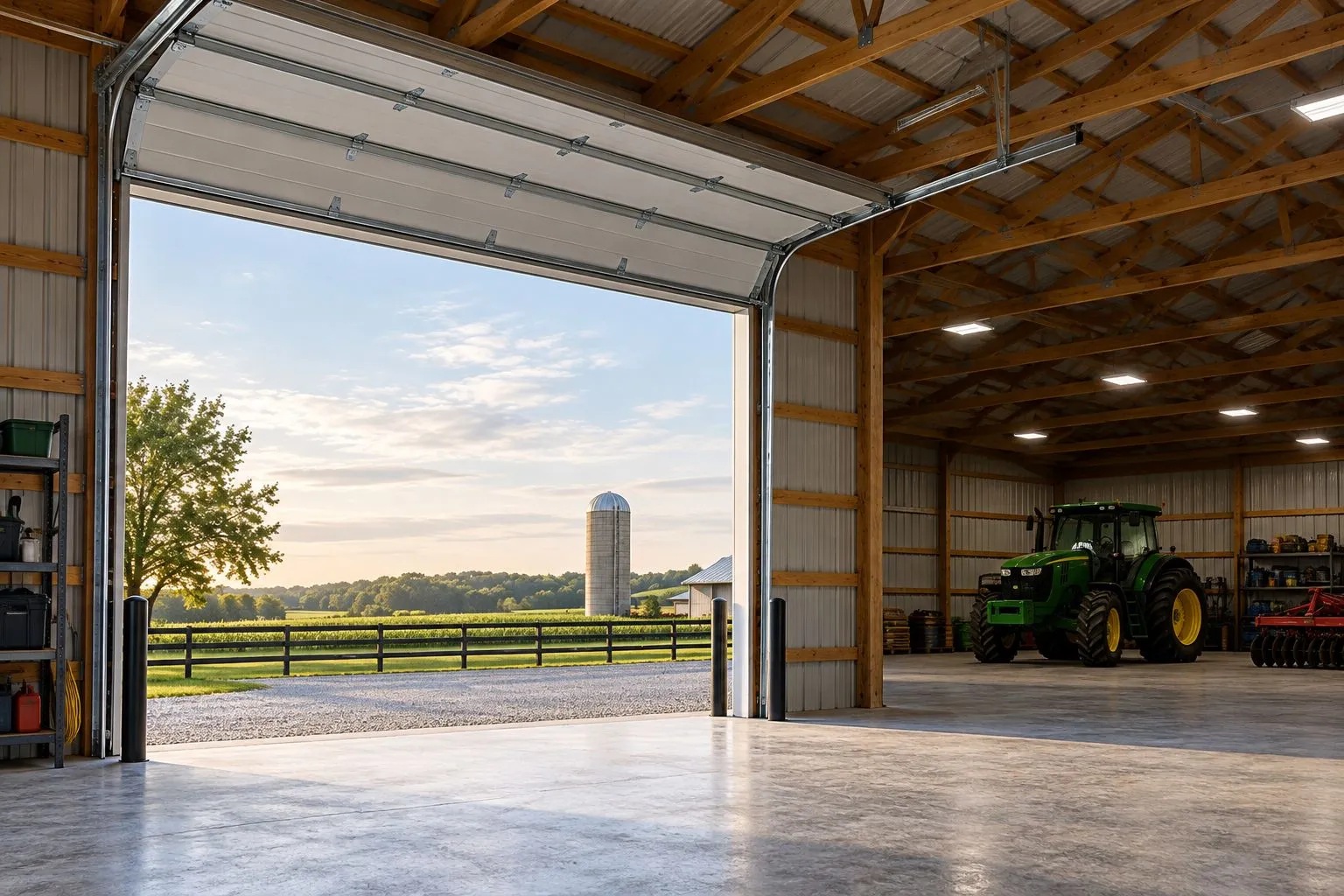
Illustrative image: check both the equipment passage and the space occupied by the open door.
Match the door to the agricultural environment
A machinery shed, heated repair shop and wash area place different demands on a door. Explain what happens near the opening instead of describing the building only as a barn.
Moisture and cleaning
Tell the installer whether equipment is washed inside or water regularly reaches the door. Ask which finishes, seals and hardware are suitable for that exposure, using the selected manufacturer’s current documentation.
A bottom seal is not a substitute for correcting drainage or a damaged threshold. If water crosses the opening, the assessment needs to include the floor and exterior approach.
Dust and contaminants
Describe dust, fertilizer storage, cleaning products and other materials near the door. Do not assume that a standard painted surface or ordinary hardware is suitable for every agricultural environment.
Ask for maintenance instructions specific to the selected system. Keep debris away from the opening, but leave spring, cable, bracket and track work to a professional.
Ventilation and building use
An insulated door is not a ventilation system. If the building houses animals or activities that generate moisture or fumes, door selection must fit the building’s ventilation plan rather than replace it.
Similarly, a large overhead opening does not automatically provide an acceptable pedestrian exit. Have the relevant building and safety requirements checked for the actual use.
Specify operation separately from door construction
Door construction and powered operation are separate decisions. A suitable curtain or sectional assembly can still perform poorly when paired with an inappropriate operator or control arrangement.
Give the installer a realistic account of daily use, including concentrated periods when equipment moves repeatedly through the opening. Request an operator recommendation based on the door’s size, weight, balance and duty requirements—not a residential opener selected by appearance.
Confirm these points in the proposal:
- How people will operate the door from each needed location.
- Which monitored safety devices the installation requires.
- How the system responds to a power interruption.
- What the manufacturer’s manual permits for manual operation.
- How pedestrian movement stays separate from machinery traffic.
Derby Strong provides commercial overhead door and opener services for business customers. Give the service team the building use and operating requirements together so the discussion covers the whole system.
Never increase operator force to overcome sticking, a heavy door or visible damage. An operator is not a repair for a mechanical fault.
Repair the existing farm door or replace it?
Replacement is not the default answer to every dent or operating problem. A professional inspection should distinguish a repairable component fault from an unsuitable or extensively damaged assembly.
Repair deserves consideration when the existing door still fits the equipment, the structure is suitable and the problem is isolated. Replacement deserves consideration when the opening no longer meets operational needs, compatible components cannot be obtained, or damage prevents a sound repair.
Stop using a door with a loose cable, displaced roller, damaged track or obvious spring problem. Keep people and equipment away; do not try to straighten hardware, release tension or force the door through a cycle.
When contacting Derby Strong about a commercial overhead door, provide photographs taken from a safe position and describe what happened before the fault. Do not operate a damaged door just to record a video.
How these overhead door options rank
The ranking follows building use, thermal needs, clear opening, mounting requirements and safe operation. It does not rank unnamed manufacturers or claim results from product testing.
Insulated sectional doors lead for heated workshops. Uninsulated sectional doors fit unheated storage, while rolling steel doors address a distinct space constraint. A site-specific layout can change the final choice.
Which farm overhead door should you choose?
Choose an insulated steel sectional overhead door for a heated Kentucky farm workshop unless the building layout rules it out. Choose an uninsulated sectional door for unheated storage, and consider rolling steel when interior track space is the limiting factor.
Before committing, request a proposal that identifies the door construction, clear opening, track or coil arrangement, mounting requirements, operator and safety devices. Resolve structural questions before installation begins.
Discuss your agricultural building door
Explain the opening, equipment clearance and building use before selecting a commercial overhead door.
Frequently Asked Questions
What’s the best overhead door for a heated Kentucky farm workshop?
An insulated steel sectional overhead door is the best starting point for a heated farm workshop. Confirm whole-assembly thermal information, perimeter seals, track clearance and structural support before selecting the door.
Is a rolling steel door better than a sectional door for a machinery building?
A rolling steel door is better when keeping horizontal tracks out of the ceiling area is the deciding requirement. A sectional door remains a practical choice when tracks fit the building and the specified construction suits its use.
Does an unheated equipment shed need an insulated overhead door?
An unheated equipment shed does not automatically need an insulated overhead door. Base the choice on present building use and any planned conversion to a heated workspace; insulation alone does not solve ventilation or moisture problems.
How do I choose the opening size for farm equipment?
Choose the clear opening around the equipment’s full travel envelope, including mirrors, cabs and fitted attachments. Have an installer evaluate the approach, threshold and installed hardware rather than relying on the framed opening alone.
Can I use a residential garage door opener on an agricultural overhead door?
Do not assume a residential opener is suitable for an agricultural overhead door. The operator must match the specified door, operating frequency, controls and required safety devices under current manufacturer instructions.
Should I repair or replace a damaged farm overhead door?
Repair is appropriate when a professional confirms that the fault is isolated and the existing assembly remains suitable. Replacement deserves consideration when the door no longer fits operational needs or cannot receive a sound repair.
What should I send when asking Derby Strong about an agricultural door?
Send Derby Strong the property location, building use, opening dimensions and safely taken photographs. Include equipment clearance needs and visible interior obstructions, without moving or testing a damaged door.
One Last Thing Before You Decide
Check the fully open door position, not just the doorway. Equipment can clear the header yet conflict with tracks, the raised door or an operator farther inside the building. Ask to see that occupied space on the proposed layout before approving the installation.
Related Garage Door Guides
- Commercial overhead door options for Kentucky warehouses
- High-lift door conversions in Northern Kentucky
- Garage door maintenance checklist
Local service: Garage door repair in Louisville · Garage door repair in Lexington · Garage door repair in Northern Kentucky