Best overall: a three-layer steel garage door with polyurethane insulation. Best for a detached parking garage: a three-layer polystyrene-insulated steel door; best basic option for occasional use: a two-layer insulated steel door. For Louisville homeowners, the right choice depends on how you use the garage, the door’s documented thermal performance, and how well the installed opening seals.
TL;DR
- For insulated garage doors Louisville KY homeowners can compare, start with construction, whole-door performance, and perimeter seals.
- Three-layer polyurethane-insulated steel is the default shortlist for an attached garage used regularly.
- Three-layer polystyrene-insulated steel suits detached parking garages when its documented performance meets your needs.
- Derby Strong provides garage door installation in Louisville; compare the proposed door specifications before choosing.
Why this matters for Louisville homeowners
Insulation inside the panels does not fix gaps around the door. A replacement decision needs to account for both heat moving through the door and air moving around it.
If your Louisville garage shares a wall with living space, insulation deserves closer attention than it does in an unconditioned building used only for parking. But an insulated garage door does not turn a garage into conditioned living space. Walls, ceilings, windows, and the connection to the house still matter.
Derby Strong provides garage door repair and installation in Louisville. Start with the condition of the existing door before deciding that replacement is necessary.
What makes the best insulated garage door?
Use these criteria to compare actual door specifications, not just brochure language:
- Documented thermal performance: Establish whether the stated rating covers the insulation, a panel section, or the complete door assembly.
- Panel construction: Compare the exterior skin, insulation core, and interior backing as a complete assembly.
- Air leakage control: Include section joints, side seals, the top seal, and the bottom seal in the assessment.
- Garage use: Separate daily workspace use from occasional vehicle access. An attached garage creates a different decision from a detached parking space.
- Installation fit: Check opening dimensions, headroom, tracks, spring requirements, and opener compatibility before ordering.
- Repair suitability: Determine whether the existing door needs replacement or a targeted repair to seals or operating components.
The best insulated door is the one whose complete assembly fits your garage and your use—not simply the one with the largest advertised R-value.
Insulated garage doors at a glance
These are construction categories, not named products. Individual models within each category differ, so the final comparison must use current manufacturer documentation.
| Door construction | Best for | Standout feature | Key limitation |
|---|---|---|---|
| Three-layer polyurethane-insulated steel | Attached garages used regularly | Insulation enclosed between steel faces | Construction alone does not establish whole-door thermal performance |
| Three-layer polystyrene-insulated steel | Detached garages used mainly for parking | Insulating core with a steel interior face | Panel thickness and insulation specifications vary |
| Two-layer insulated steel | Occasional-use detached garages | Exterior steel skin with insulation behind it | No full interior steel skin; backing varies by model |
Do not treat every door described as “insulated steel” as equivalent. A door with an enclosed core and a door with exposed or lightly covered insulation have different interior surfaces and construction.
1. Polyurethane-insulated steel: best for attached garages
A three-layer polyurethane-insulated steel door places a foam core between exterior and interior steel skins. This construction belongs on your shortlist when you regularly use an attached garage and want an enclosed interior surface.
“Three-layer” describes 3 construction layers, not a guaranteed performance level. Confirm the exact model’s thermal data, glazing configuration, and section details before selecting it.
Polyurethane-insulated steel pros:
- Encloses the insulation behind an interior steel face.
- Provides a finished surface on the garage side.
- Offers a construction category suited to evaluating higher thermal-performance goals.
Polyurethane-insulated steel cons:
- Does not eliminate leakage at damaged or poorly fitted seals.
- Requires model-specific documentation; the insulation type alone is not a whole-door rating.
- Does not establish whether your existing opener or tracks can be retained.
Best for: An attached Louisville garage used regularly for parking, storage, or household tasks.
Verdict: Buy this construction when the documented performance and installed fit match your needs.
2. Polystyrene-insulated steel: best for detached parking garages
A three-layer polystyrene-insulated steel door uses an insulating core between steel faces. It gives you an enclosed interior surface without requiring you to choose polyurethane by default.
For a detached garage used mainly to park vehicles, compare this construction against your actual comfort goals. Do not reject or select it solely because of the insulation’s name.
Polystyrene-insulated steel pros:
- Keeps the insulating core behind a steel interior face.
- Provides an interior surface suited to ordinary garage use.
- Gives you another enclosed-panel option to compare using published specifications.
Polystyrene-insulated steel cons:
- Performance differs with the specific panel assembly.
- Insulation cannot compensate for an uneven closing surface or perimeter gaps.
Best for: A detached parking garage where an enclosed interior face matters more than pursuing the highest advertised insulation figure.
Verdict: Buy when its documented thermal performance meets your use case.
3. Two-layer insulated steel: best for occasional-use garages
A two-layer insulated steel door combines an exterior steel skin with insulation behind it. It has 2 primary construction layers, rather than the steel-insulation-steel arrangement above; the insulation’s interior covering depends on the model.
This is a basic construction option for a detached garage you enter briefly. Check the interior backing closely, especially where stored equipment could contact the door.
Two-layer insulated steel pros:
- Adds insulation behind the exterior steel skin.
- Provides a straightforward alternative to an enclosed sandwich panel.
- Lets you prioritize basic garage use rather than a finished interior steel face.
Two-layer insulated steel cons:
- Lacks the full interior steel skin of a three-layer door.
- Backing and protection of the insulation vary by model.
- Is not the default recommendation for a regularly occupied attached garage.
Best for: An occasional-use detached garage where interior finish is a secondary concern.
Verdict: Buy only when the backing, performance, and intended use align; otherwise, skip.
How these options are ranked
The ranking prioritizes regular attached-garage use first, detached parking second, and occasional access third. It weighs enclosed construction, documented thermal performance, sealing, and installation fit—not an unsupported claim that one insulation material always wins.
Use this as a buying framework for your 2026 replacement project. The exact door specification should decide the purchase, not the category label.
Compare thermal ratings without mixing measurements
R-value measures resistance to heat flow; U-factor measures heat transfer. Higher R-values indicate greater resistance, while lower U-factors indicate less heat transfer. Those comparisons only work when the measurements describe comparable assemblies and test conditions.
An insulation-core R-value is not interchangeable with a complete-door rating. A steel door has 1 exterior steel skin before you account for its core, backing, joints, windows, and perimeter conditions; evaluating only the core leaves out important parts of the assembly.
Ask for these distinctions in writing:
- Panel rating: What part of the door was measured?
- Whole-door rating: Does the measurement include the complete assembly?
- Window specification: Does the rating apply to the glazing you selected?
- Air leakage: What information describes leakage through the closed assembly?
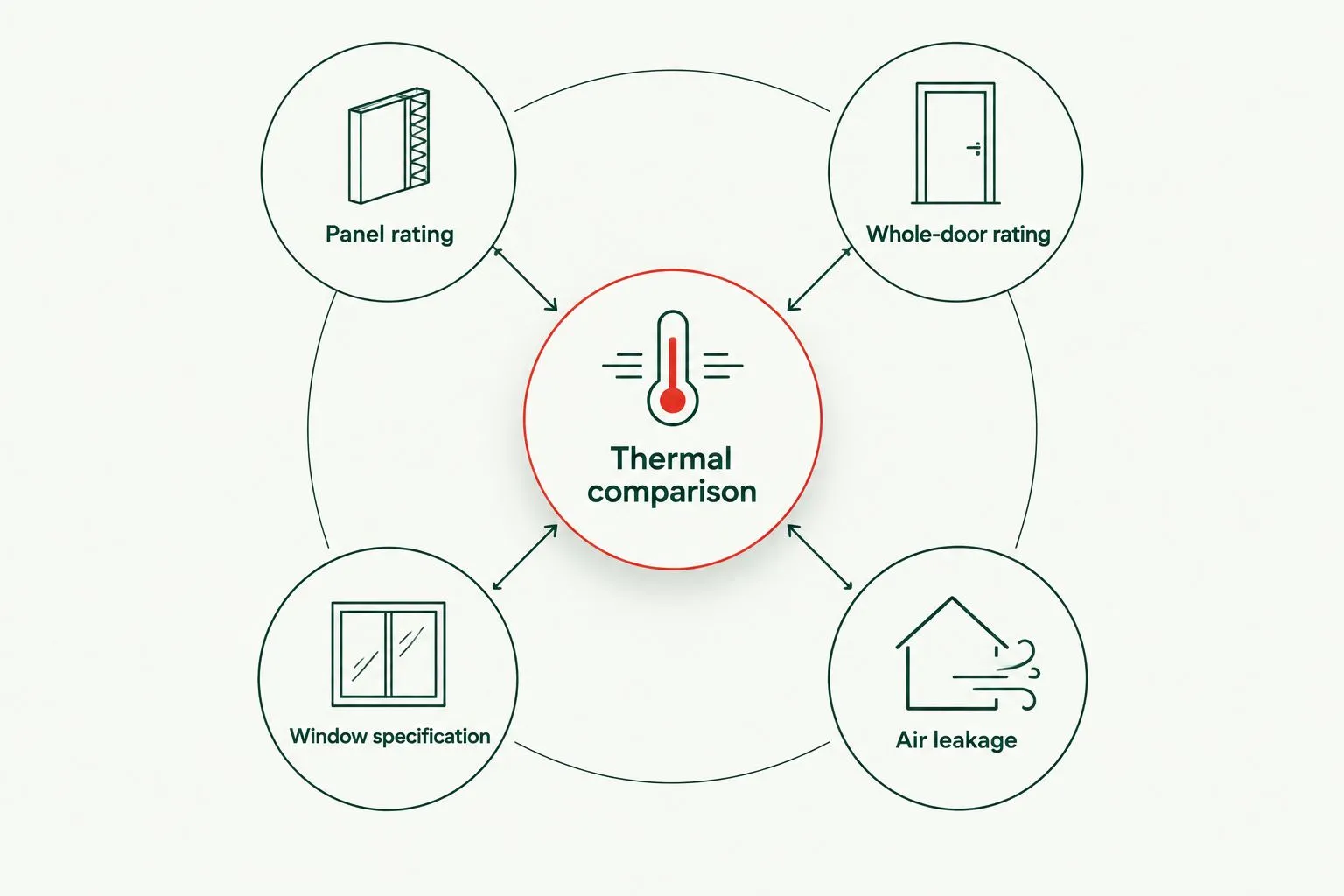
Compare the complete assembly rather than treating an insulation-core rating as a door rating.
Cold-weather comparisons make the same distinction: evaluating insulated garage doors for winter requires attention to the complete assembly, not just the foam inside a panel. For your Louisville home, relate those specifications to whether the garage is attached, how you use it, and where air enters.
Do not translate a thermal rating into a promised room temperature or utility-bill reduction. That conclusion requires information about the building and its operation, not just the garage door.
Check seals before replacing a sound door
If your existing door operates normally, observe it from inside with the door closed. Look for visible light at the sides, top, and bottom without touching tracks, cables, brackets, or springs.
Visible gaps identify areas for inspection; they do not establish the repair by themselves. Worn weatherstripping, an irregular floor, damaged sections, and alignment problems require different responses.
Separate these decisions:
- Seal repair: Appropriate to assess when the door is otherwise serviceable and the problem is concentrated around the opening.
- Panel repair: Worth assessing when damage is limited and a compatible repair is possible.
- Door replacement: Appropriate to evaluate when the assembly’s condition or construction no longer meets your needs.
Do not replace a serviceable door just because the garage feels drafty. First identify whether the problem is air leakage, panel performance, or another part of the building.
If the door hangs crooked, has a loose cable, or appears damaged, stop operating it. Do not force it closed or increase opener force to overcome the fault.
Make the installed specification part of the decision
A better-insulated replacement is still a moving door assembly. The installer needs to assess its weight, counterbalance requirements, tracks, clearances, mounting conditions, and opener compatibility together.
Ask Derby Strong to evaluate the proposed insulated garage door against the existing opening. Do not assume that keeping the old opener or tracks is either necessary or appropriate before that assessment.
Your written scope should identify:
- The manufacturer and exact door model.
- Panel construction and insulation type.
- The thermal rating and what it measures.
- Windows, glazing, and interior backing.
- Perimeter and bottom sealing work.
- Track, spring, hardware, and opener decisions.
Use the Louisville garage door replacement quote guide to separate the door specification from the installation scope. Two proposals are not directly comparable when one leaves those decisions unstated.
Spring, cable, track, and bracket work belongs to a professional. Do not add insulation kits or other weight to an existing door without having the effect on balance and operation assessed.
Which insulated garage door should you choose?
Choose three-layer polyurethane-insulated steel as your starting point for an attached Louisville garage used regularly. Then compare the exact model’s whole-door information, seals, windows, and installation requirements.
Choose three-layer polystyrene-insulated steel when a detached parking garage needs an enclosed interior face and its documented performance meets your goals. Choose two-layer insulated steel only when occasional use and the proposed backing make that simpler construction appropriate.
Derby Strong provides insulated garage door installation for Louisville homeowners; the purchase decision should rest on the proposed assembly and its fit, not an insulation label alone.
Frequently Asked Questions
What is the best insulated garage door for an attached Louisville home?
A three-layer polyurethane-insulated steel door is the starting recommendation for an attached garage used regularly. Confirm the exact model’s thermal performance, seals, windows, and installation requirements before choosing.
Is polyurethane always better than polystyrene in a garage door?
No. Compare the documented performance of the complete door assemblies rather than assuming the insulation material alone decides the result. Panel construction, glazing, and sealing also matter.
Will an insulated garage door keep my garage warm without heat?
An insulated garage door does not provide heat. It resists heat transfer through the door, but garage temperature also depends on air leakage, the rest of the building, and how often the door opens.
Should I compare garage doors by R-value or U-factor?
Compare ratings that describe equivalent assemblies and test conditions. Higher R-value indicates more resistance to heat flow; lower U-factor indicates less heat transfer, but a core rating is not a complete-door rating.
Do I need a new garage door if cold air comes around the edges?
Not necessarily. Have the seals, closing surface, door condition, and alignment assessed before replacing an otherwise serviceable door. Insulated panels do not repair perimeter gaps.
Can I keep my opener when I install an insulated garage door?
Your existing opener needs an assessment against the replacement door and installation. Door balance, condition, compatibility, and manufacturer requirements determine whether retaining it is appropriate.
Can I add insulation to my existing garage door myself?
Do not add weight without having the door’s balance and operation assessed. Added insulation does not fix worn seals, and spring or cable adjustments are professional-only work.
One Last Thing Before You Decide
Read the specification for the door with your chosen windows—not just the solid-panel version. Glazing changes the assembly you are buying, so confirm that the thermal information applies to the actual configuration.
Before approving the order, ask one direct question: “Does this performance information describe the door you are installing?” That answer is more useful than another insulation label.
Related Garage Door Guides
- Should you repair or replace your Louisville garage door?
- Choosing garage door styles for Louisville homes
- Choosing private garage door windows in Louisville
Local service: Garage door installation in Louisville