A storm-damaged Northern Kentucky garage door should be replaced when a professional assessment finds that repair cannot restore safe movement, secure attachment and proper closing. An isolated damaged component or replaceable section does not automatically justify a new door. Damage to the opening, electrical equipment or supporting structure needs separate attention; replacing the door alone does not resolve those problems.
TL;DR
- Garage door storm damage replacement Northern Kentucky decisions depend on structural damage, not dents alone.
- Repair isolated damage only when the remaining door and supporting components can operate safely.
- Stop using a crooked, jammed or partly detached door; leave tension-system repairs to professionals.
- Derby Strong provides garage door repair and installation for Northern Kentucky homeowners and businesses.
Should a storm-damaged Northern Kentucky garage door be replaced?
Replace the door when a suitable repair cannot restore its structural integrity and safe operation. Repair remains a valid choice when damage is isolated and the remaining assembly is sound. The assessment must cover the door, its supporting hardware and the building opening—not just the most visible dent.
Derby Strong provides garage door repair and installation in Northern Kentucky. For this problem, request an assessment that explains what failed, what remains usable and whether repair addresses the full damage.
| Option | Best for | Main advantage | Main limitation |
|---|---|---|---|
| Component repair | Isolated hardware, sealing or opener faults with an otherwise sound door | Addresses the specific fault without replacing sound sections | Does not correct damaged sections or compromised structural attachment |
| Section replacement | Damage confined to a section with a suitable compatible replacement | Retains the undamaged portion of the door | Depends on compatibility and the condition of the remaining assembly |
| Complete door replacement | Widespread section damage or damage that cannot be safely repaired | Replaces the damaged door assembly | Does not repair a damaged building opening or unrelated electrical faults |
These options are not interchangeable. A new opener does not straighten a bent door, and a new door does not repair loose framing. Ask the professional to connect the proposed work to the observed failure.
Why this matters after a Northern Kentucky storm
A garage door is a large moving assembly supported by tracks, attachments and a spring system. Storm damage can affect more than its outer surface. A door that still responds to the wall control is not proof that the assembly is safe.
For a Northern Kentucky homeowner, the immediate question is whether the garage can be secured without operating damaged equipment. For a commercial customer, the same safety boundary applies, but the assessment also needs to account for vehicle access, staff movement and the building’s use. Do not keep a damaged overhead door running just to maintain access.
Which storm-damage signs mean you should stop using the door?
Stop operating the door when it is crooked, jammed, partly detached or visibly out of its tracks. Keep people and vehicles away from the opening. Do not stand beneath a damaged raised door or attempt to hold it up.
A dent alone does not establish the need for replacement. Its location and effect matter: damage near a section joint, hinge attachment or roller connection deserves more attention than an isolated surface mark.
| Observation from a safe position | What it means for the assessment | What you should do |
|---|---|---|
| Door sits crooked or one side hangs lower | The support or lifting system needs inspection | Stop operation and keep the opening clear |
| Section is creased, split or pulled apart | Section strength and connections need assessment | Do not try to straighten or force the section |
| Roller is outside the track or track has pulled away | The door is not properly guided or supported | Leave track and attachment work to a professional |
| Cable is loose, displaced or visibly damaged | The lifting system needs professional attention | Do not touch cables, drums or bottom brackets |
| Door surface is dented but alignment appears unchanged | Visible damage alone does not settle repair versus replacement | Document the damage without cycling the door to test it |
| Water reached the opener or electrical connections | Electrical safety requires separate assessment | Do not energize or test affected equipment |
A damaged door can also conceal faults behind its visible face. Take photographs from a stable position, but do not move closer to inspect a loose attachment or reach into a section joint.
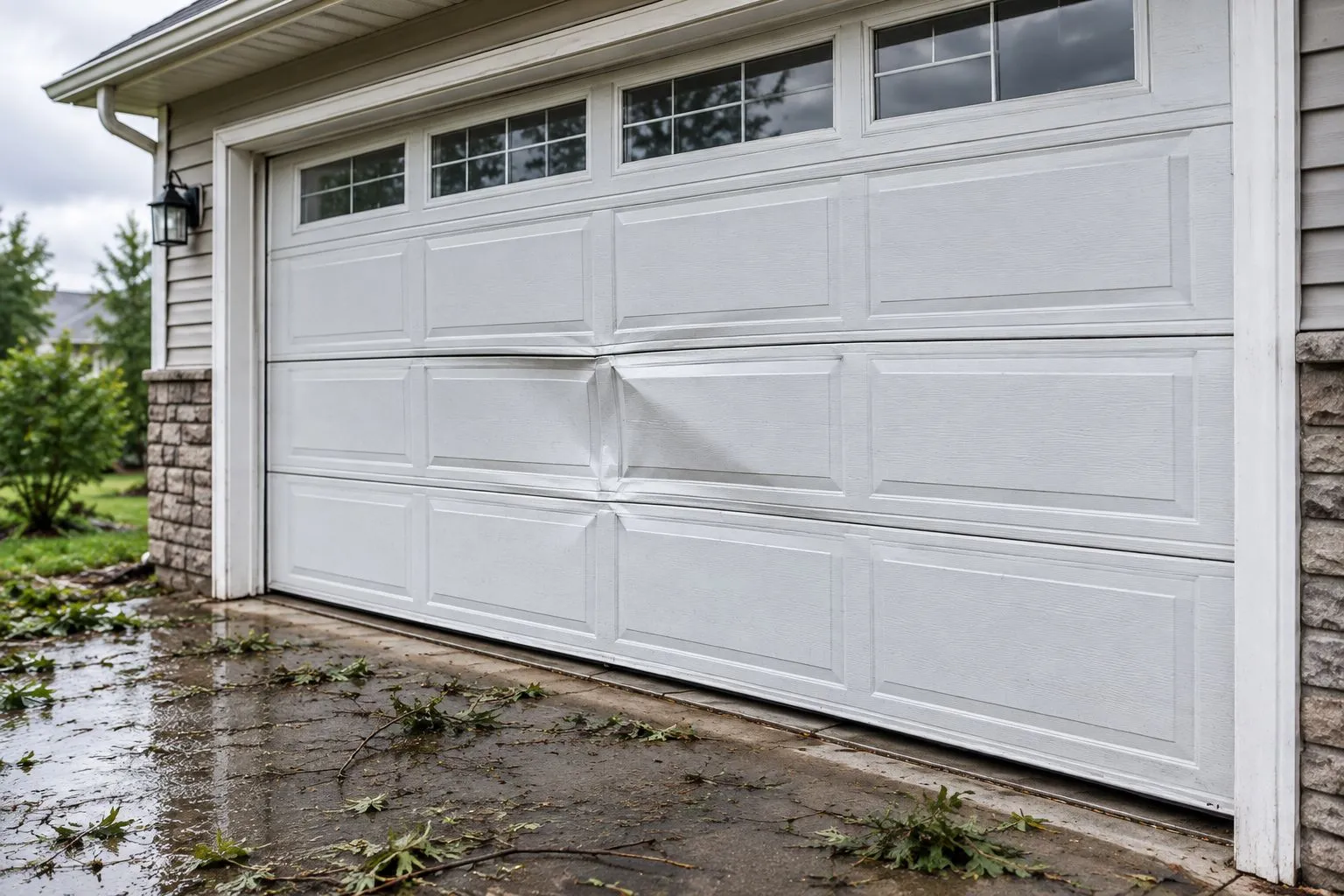
Illustrative photo: a visible crease needs assessment of the section and its connections, not just its appearance.
When is repair the better choice?
Repair is appropriate when the damaged part can be corrected or replaced and the remaining door assembly is suitable for continued use. The professional should explain how the repair restores function without leaving another damaged component in service.
A displaced weather seal, an isolated opener fault or limited section damage calls for different work. Avoid treating all storm-related symptoms as a single replacement problem. Separate the door’s mechanical condition from its sealing and electrical condition.
Component repair: best for isolated faults
Component repair makes sense when the fault is confined to a serviceable part and the supporting door structure remains sound. Its advantage is scope: sound parts stay in place. Its limitation is that it cannot compensate for damage elsewhere.
Ask whether the proposed component failed because of another damaged part. Replacing a roller without addressing the track or section that displaced it does not resolve the underlying problem. This is a diagnostic question for the service professional, not a repair task for the owner.
Section replacement: best for localized section damage
Section replacement is an option when a compatible section can be fitted and the rest of the door remains suitable. Compatibility involves more than matching the exterior pattern; dimensions, connections and the assembled door’s balance also matter.
The benefit is retaining sound sections. The limitation is dependence on a suitable replacement and the condition of adjoining sections. Ask whether the proposed section restores the complete assembly, rather than merely covering the visible damage.
When is complete replacement justified?
Complete replacement is justified when section damage is widespread, connections are compromised or a suitable repair cannot restore a safe assembly. It also becomes the appropriate option when the required replacement section is incompatible with the existing door.
Ask for a damage-based explanation, not a recommendation based only on the door’s age. Age is useful background, but the replacement decision should identify what is damaged and why the proposed repair will not resolve it.
Complete replacement: best for damage beyond a suitable repair
A replacement door addresses damaged door sections and the components included in the specified installation. Its advantage is replacing an assembly that cannot be restored appropriately. Its limitation is scope: damaged framing, water-affected wiring and other building repairs still require attention.
Before approving replacement, establish what the work includes. Ask how the installer will assess the opening, track attachments, spring system and any existing opener proposed for reuse. Do not assume that every existing component belongs with the new door.
What changes the repair-versus-replacement decision?
The decision depends on the damage pattern and the condition of the complete assembly. Use these factors to compare the explanation behind each proposal:
- Damage location: A mark on the outer surface raises different concerns from damage at a joint, hinge or lifting attachment.
- Damage extent: An isolated affected section differs from deformation across several connected sections.
- Remaining door condition: Undamaged-looking sections still need assessment of their connections and function.
- Replacement compatibility: A section repair needs a suitable match for the assembled door, not just a similar appearance.
- Opening and attachment condition: Door work cannot substitute for repairs to compromised supporting structure.
- Electrical exposure: Water-affected opener equipment needs separate attention before powered operation resumes.
These factors explain why photographs alone do not settle every case. Photos help document visible damage; an inspection establishes how the parts interact and whether the proposed work restores safe use.
How should you prepare for a professional assessment?
Prepare information without testing or dismantling the damaged door. Your job is to document observations and keep access safe—not to prove that the door still works.
- Stop operation. Keep the remote and wall control from being used accidentally. Do not cycle the door to reproduce a noise or show the fault.
- Document damage. Photograph the overall opening and visible damaged areas from a safe position. Record whether the door was open or closed when the damage occurred, if you know.
- Record symptoms. Describe what you already observed: a crooked position, new gap, displaced roller, unusual noise or failure to close. Distinguish observations from guesses about the cause.
- Arrange assessment. Explain whether the garage contains a trapped vehicle, whether the opening is unsecured and whether water reached electrical equipment. Let the professional determine the safe work sequence.
Those 4 preparation steps do not include releasing springs, removing brackets or moving a damaged door by hand. Do not pull the emergency release on a raised or damaged door to see whether it will move; disconnecting it from the opener can create an uncontrolled movement hazard.
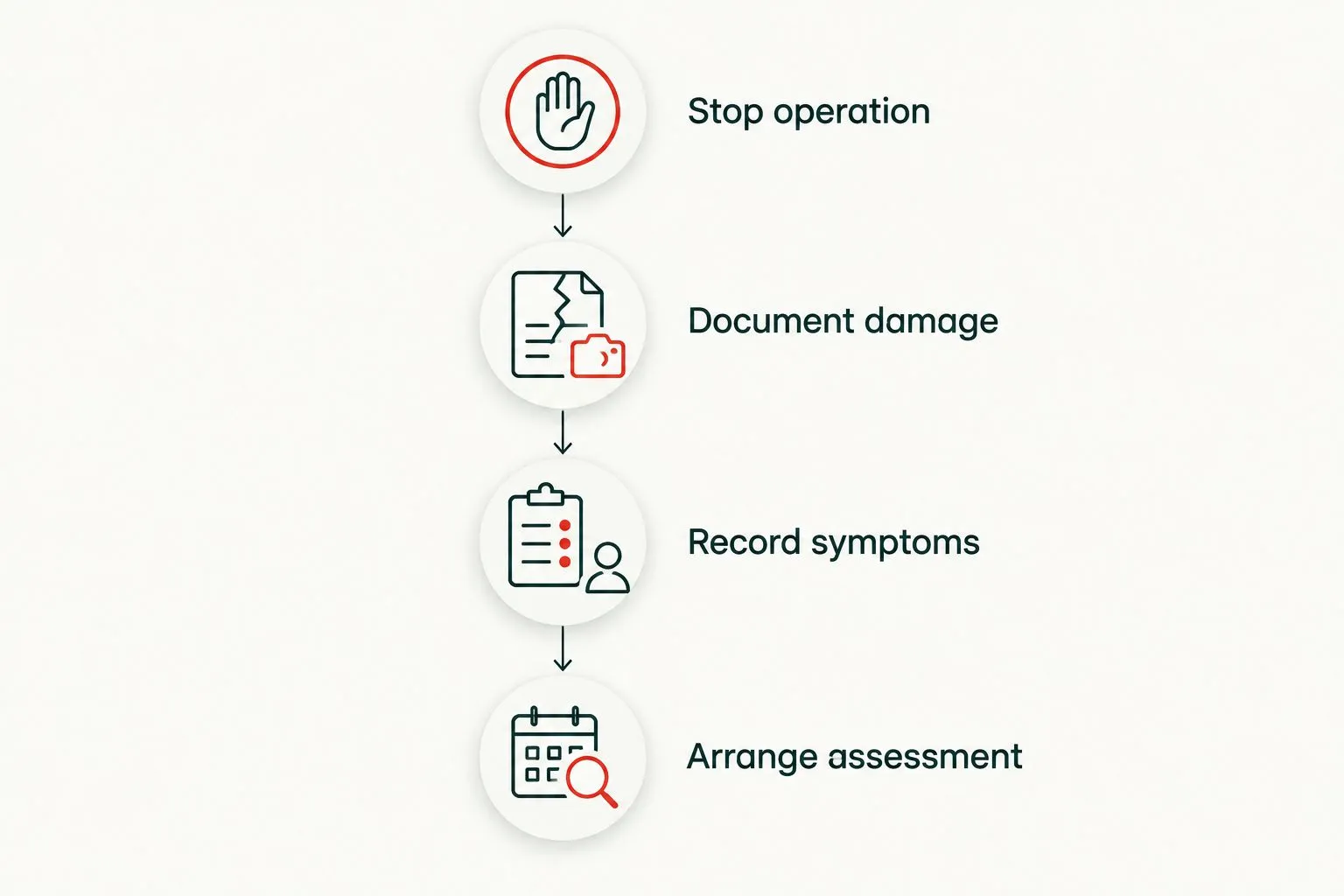
Document what you can see without operating or dismantling the damaged door.
Keep pets and children away from the opening. If a vehicle is trapped, tell the service professional before the visit; do not create another hazard by trying to lift the door. If there is immediate danger from unstable building material or electrical exposure, stay clear and contact the appropriate emergency service.
What should a repair or replacement proposal explain?
A useful proposal answers 3 questions: what failed, how the work corrects it and what remains outside the scope. A replacement recommendation without that explanation does not help you compare the options.
Ask for the damaged components to be identified in plain language. If repair is proposed, ask which existing parts remain and why they are suitable. If replacement is proposed, ask why component or section repair will not restore the door safely.
For installation work, ask how the proposed door suits the opening and intended use. Any wind-performance claim should refer to the proposed door’s current manufacturer documentation and applicable installation requirements. Do not assume that a heavier-looking door or thicker insulation establishes its wind performance.
Arrange a door assessment
Discuss storm damage, safe operation and repair-versus-replacement options for your Northern Kentucky garage.
Can a storm-dented garage door be repaired?
A storm-dented garage door can be repaired when the affected component or section is suitable for repair and the complete assembly can operate safely afterward. Appearance alone does not settle the question. Ask whether the dent affects a joint, connection, alignment or structural function.
Should you replace the opener after storm damage?
You should replace the opener only when its condition, compatibility or documented requirements justify replacement. A damaged door does not automatically mean the opener failed. Water exposure or visible electrical damage requires separate assessment before the equipment is used.
Does an insurance claim decide whether the door needs replacement?
An insurance claim does not determine the door’s mechanical repairability. The damage assessment explains the necessary work; your policy and claim review determine coverage. Keep photographs, the written assessment and the proposed scope together without assuming that any particular repair will be covered.
Frequently Asked Questions
Should I replace my Northern Kentucky garage door after a storm?
Replace a storm-damaged garage door when a professional assessment finds that a suitable repair cannot restore structural integrity and safe operation. Isolated damage does not automatically require complete replacement.
Can just one damaged garage door section be replaced?
One damaged section can be replaced when a compatible section is suitable and the remaining assembly is sound. The assessment must also address adjoining connections and door balance.
Is it safe to open a garage door that looks crooked?
A crooked garage door should not be operated until it has been professionally assessed. Keep people away and do not force it, adjust its tracks or increase opener force.
Can I pull the emergency release after my garage door is damaged?
Do not pull the emergency release on a raised or damaged door to test its movement. Disconnecting the opener can allow uncontrolled movement when the door’s support or balance is compromised.
Does storm damage mean I need a new garage door opener too?
Storm damage does not automatically require a new opener. The opener needs its own assessment, especially when water reached electrical equipment or replacement-door compatibility is in question.
What should I tell Derby Strong before a storm-damage assessment?
Tell Derby Strong the door’s current position, the visible damage, any symptoms already observed and whether water reached electrical equipment. Mention trapped vehicles or an unsecured opening without operating the door to demonstrate the problem.
What documentation should I keep for a storm-damaged garage door?
Keep photographs taken from a safe position, a record of your observations and the written assessment and proposed work. Ask your insurer what additional documentation the claim requires.
One Last Thing Before You Decide
Do not let the most obvious dent become the entire diagnosis. Before approving work, ask the professional to explain the condition of 3 areas: the door sections, the supporting hardware and the building opening. A repair or replacement decision is useful only when it addresses the assembly—not just its appearance.