A full-view glass garage door is practical for a Lexington home when you want daylight and can meet your privacy, comfort and security needs with the actual glass specification. Do not choose clear glass for a street-facing garage you need to keep private: obscured glass reduces detail, but you still need to check nighttime visibility, thermal performance and installation fit before ordering.
TL;DR
- Full view garage door privacy Lexington decisions should start with nighttime visibility, not a daytime showroom sample.
- Clear glass suits garages where visibility is acceptable; obscured glass reduces detail but does not guarantee nighttime privacy.
- Derby Strong provides garage door installation in Lexington; choose the glass specification before committing to a new door.
- Compare whole-door thermal performance and site requirements, not glass appearance alone.
Is a full-view glass garage door practical for a Lexington home?
Yes, if the door’s appearance and daylight are useful to you and its privacy limits fit how you use the garage. A garage used for parking and visible storage presents a different privacy problem from one used as a workshop or exercise space. Start with what someone outside must not be able to see.
Derby Strong provides garage door installation in Lexington. For this decision, the useful service question is whether the proposed door fits your opening, hardware requirements and intended use—not simply whether a glass door can be installed.
| Door or glazing option | Best for | Main benefit | Main limitation |
|---|---|---|---|
| Full-view door with clear glass | Homeowners comfortable with visible garage contents | Daylight and an unobstructed view | Offers little visual privacy without another barrier |
| Full-view door with obscured glass | Homeowners wanting daylight with less visible detail | Diffuses the view into the garage | Silhouettes and light can remain visible; performance depends on the glass |
| Full-view door with tinted glass | Homeowners prioritizing glare reduction over concealment | Changes light transmission and appearance | Tint alone is not dependable nighttime privacy |
| Opaque insulated door | Homeowners prioritizing concealment and temperature control | Blocks views through the door panels | Does not provide the full-view glass appearance or equivalent daylight |
The best choice is the door that meets your privacy needs when the garage lights are on. A glass finish that looks private from outside during daylight is not enough evidence for that decision.
Why this matters for a Lexington homeowner
A garage door is a large opening, and its glazing affects more than curb appeal. It changes what passersby can see, how daylight enters and how the enclosed space exchanges heat with the outdoors.
The practical question is not whether a full-view door looks good on a Lexington house. It is whether you can live with that exact door while parking, working, storing belongings and using the garage after dark. Set those requirements before comparing finishes.
Clear glass: best for daylight when visibility is acceptable
Clear glass makes sense when you want a view through the door and do not rely on the door to conceal the garage interior. It gives the most direct connection between indoor and outdoor views, but that connection works in both directions.
Look at the garage from places people normally pass or stand. Consider the driveway, public approach and neighboring sightlines without assuming that distance alone provides privacy. Shelving, parked vehicles and work areas visible through the proposed glazing belong in this assessment.
Clear glass is a poor match when the main goal is hiding tools, storage or daily activity. An interior screen can interrupt views, but it also changes the appearance and usefulness of the glass. Any separate screen must stay outside the door’s travel path and away from moving hardware.
Choose clear glass only if seeing into the garage is acceptable, not because you expect to solve privacy later.
Obscured glass: best for daylight with reduced detail
Obscured glass changes how clearly you can see objects through it. Frosted and textured treatments can reduce recognizable detail while admitting light, but obscured does not mean opaque.
The result depends on the specific material, lighting and distance between a person or object and the glass. Someone close to the inside face can be more apparent than an object farther back. Bright interior lighting also changes the view from outside.
Ask to examine the exact proposed glass rather than a finish with a similar name. Compare its appearance against both a bright background and a darker background, and place an object behind the sample. A small sample is useful for understanding the finish, but it does not reproduce the entire installed door.
Choose obscured glass for reduced detail; require a separate solution if your standard is no visible silhouettes.
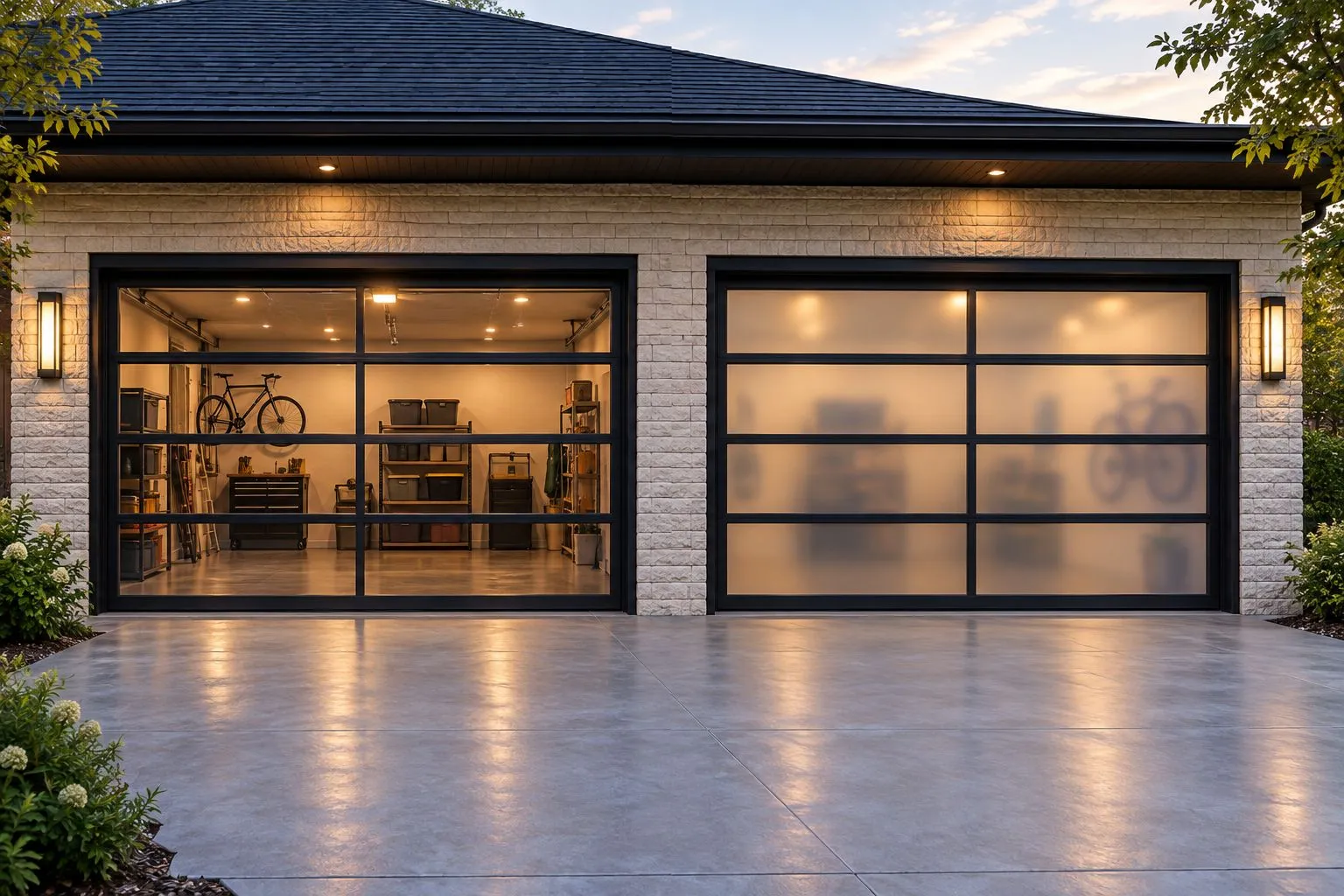
Illustrative photo: obscured glass reduces detail rather than making the opening opaque.
Tinted glass: best for managing light, not guaranteeing privacy
Tint changes the amount and character of light passing through glass. It can make a door appear darker from outside, but that appearance is not a reliable promise that the garage interior will stay hidden.
Visibility depends partly on the light difference across the glass. When the garage is brightly lit and the exterior is dark, the indoor view can become easier to see. Do not treat a daytime reflection as proof of nighttime concealment.
Ask what the proposed tint is intended to do and request its manufacturer documentation. If privacy is the deciding requirement, evaluate visibility separately from glare reduction or the color of the door.
Choose tinted glass for its documented light-control properties, not as a substitute for a privacy assessment.
Why full-view garage door practicality varies
The same glass finish can suit one Lexington home and disappoint another. These factors determine whether it fits your property:
- Exterior sightlines: A door facing a public approach exposes different views from one screened by existing site features. Check actual viewing positions.
- Lighting contrast: Interior lights affect what someone outside can see after dark. Evaluate the garage under its intended lighting.
- Garage use: Parking, storage, exercise and workshop activities create different expectations for concealment and comfort.
- Glass and frame specification: Privacy treatment, glazing construction, framing and perimeter seals serve different purposes. A finish name does not describe all of them.
- Existing opening and hardware: Door dimensions, overhead space, track arrangement and opener requirements affect installation suitability. Have these assessed before ordering.
- Property restrictions: Applicable association rules or approval requirements can limit visible exterior changes. Check the requirements for your property rather than assuming approval.
How do you check privacy before choosing the glass?
Check privacy from outside under the conditions that matter to you. A photograph of a finished door can help you judge style, but it cannot establish how the proposed glass will behave in your opening.
Use this sequence to make the choice more concrete:
- Set requirements. Write down what must stay hidden: stored belongings, people, work surfaces or all interior detail. Distinguish reduced visibility from complete concealment.
- Check sightlines. Identify ordinary viewing positions outside your garage. Do not enter a neighbor’s property to inspect them.
- Compare samples. Request the exact glazing option being proposed. Look through it with objects behind it and different lighting on each side.
- Review specifications. Confirm the glass treatment, thermal information, cleaning guidance and installation requirements in current documentation.
- Confirm fit. Have a professional assess the opening, supporting hardware and opener compatibility before you approve the door.
Keep the decision tied to your own garage. A display with dark shelving behind the glass tells you less about a brightly lit exercise area, and an attractive exterior photograph tells you little about nighttime visibility.
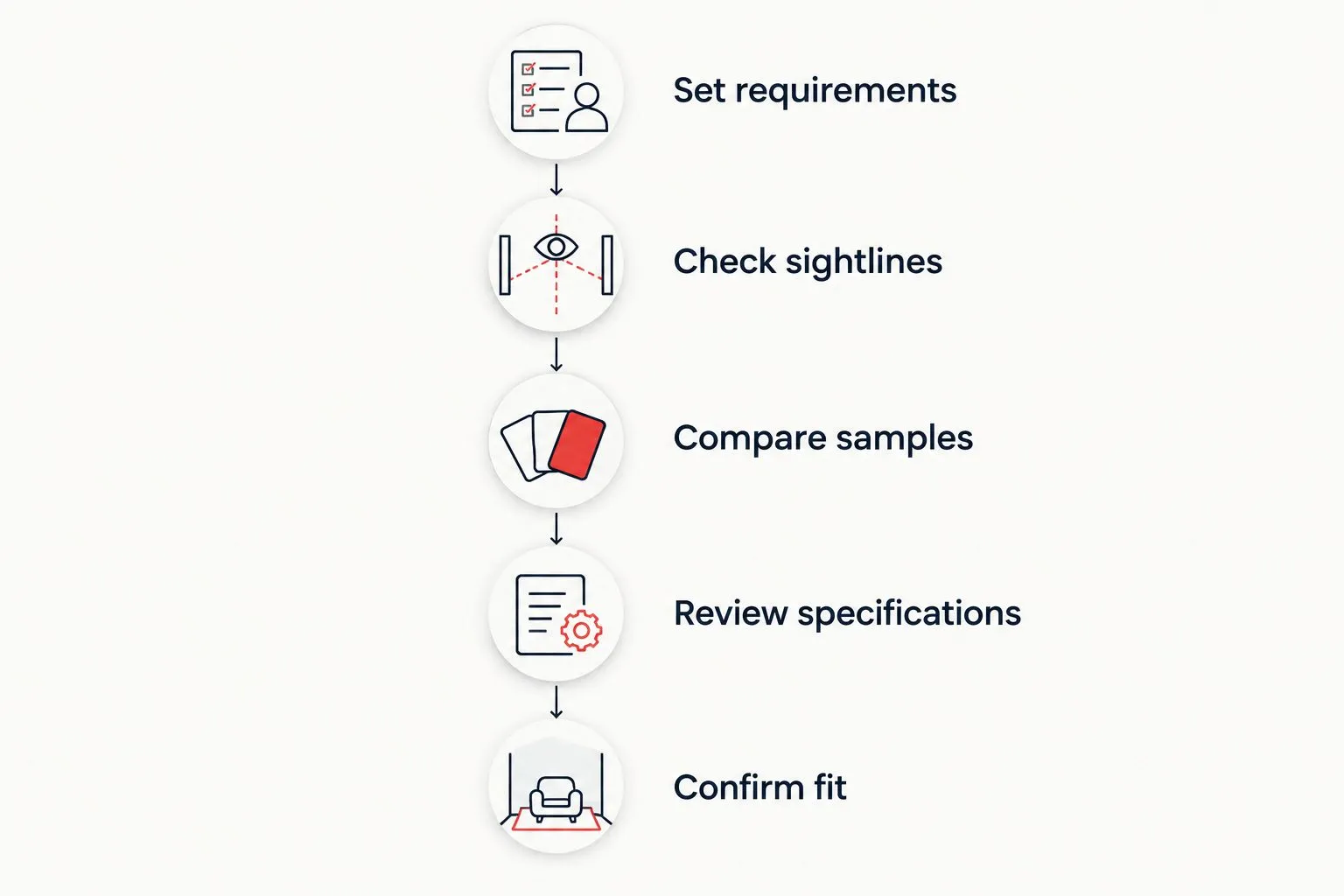
Start with the visibility you need, then evaluate the glazing and installation fit.
Does insulated glass make a full-view door comfortable?
Insulated glass is only part of the thermal assessment. The complete door also includes frames, panel connections and seals, each of which affects heat transfer or air leakage.
Ask whether any quoted thermal value describes the glass alone or the complete door. Those are different scopes. Comparing a glass-only figure with a whole-door figure does not give you a sound basis for choosing between doors.
Also separate insulation from air sealing. A glazing upgrade does not correct gaps around the opening, and a good perimeter seal does not change the insulating properties of the glass. Condensation depends on surface temperature and moisture conditions; it is not automatically proof that a door is defective.
For a conditioned garage, evaluate the complete enclosure rather than assuming insulated glass will maintain room-like comfort. Include the garage walls, ceiling, adjacent spaces and heating or cooling arrangement in the discussion.
What should you check before replacing the existing door?
First, distinguish an appearance preference from a repair need. If your existing door operates safely and meets your privacy requirements, replacing it with glass is a design choice—not evidence that the current door has failed.
If the current problem is a draft, damaged seal or opener fault, ask whether a targeted repair addresses it. New glazing does not solve every access or comfort issue. Derby Strong provides garage door repair and opener service as well as installation in Lexington, so the service discussion can include those alternatives.
Before approving replacement, request confirmation of:
- The proposed door dimensions and the opening measurements used.
- The space required for tracks, hardware and the open door.
- The appropriate spring system and supporting components for the proposed door.
- Whether the existing opener is suitable for that door.
- The exact glazing specification and manufacturer care instructions.
- Any property approvals or applicable installation requirements.
Leave spring, cable, track and bracket work to a professional. Do not change opener force to push through binding, and do not force a damaged door while checking the opening.
Can a full-view glass door protect stored belongings?
A glass garage door does not provide visual concealment unless its glazing or another barrier blocks the view sufficiently. Privacy, resistance to breakage and access control are separate requirements.
Ask what safety glazing is specified and how the complete door secures when closed. Do not assume that frosted glass is stronger than clear glass, or that a darker tint improves security. An appearance treatment does not establish impact performance.
Review what is visible through the proposed door before arranging storage. If the door would reveal items you need concealed and the glass cannot meet that requirement, an opaque door is the more direct solution.
Frequently Asked Questions
Is a full-view glass garage door practical for a Lexington home?
A full-view glass garage door is practical when its privacy, thermal performance and installation requirements fit your garage. Evaluate the exact glazing under interior lighting before choosing it for a street-facing opening.
What’s the best glass garage door option for privacy?
Obscured glass is a better starting point than clear glass when you want daylight with less visible detail. It does not guarantee that silhouettes disappear, so choose an opaque barrier when complete concealment is required.
Can people see through frosted garage-door glass at night?
People can see light and silhouettes through some frosted garage-door glass at night. The result depends on the glass treatment, lighting and how close objects or people are to the glass.
Is tinted garage-door glass better than frosted glass for privacy?
Tinted glass is not a dependable substitute for obscured glass when privacy is the goal. Tint changes light transmission, while frosting or texture changes how clearly details are visible; assess the exact options separately.
Will insulated glass keep my garage comfortable?
Insulated glass alone does not establish how comfortable the garage will be. Review whole-door thermal performance, perimeter sealing and the rest of the garage enclosure.
Can I keep my existing opener with a new glass garage door?
Keep the existing opener only after a professional confirms it is suitable for the proposed door. The door’s weight, balance and installation requirements must be assessed together; increasing opener force is not a compatibility fix.
Should I replace my garage door just to fix a draft?
A draft alone does not establish that the entire door needs replacement. Have the seals, opening and door condition assessed first, then compare a targeted repair with replacement.
What should I prepare before requesting glass garage-door installation?
Prepare your privacy requirements, photographs of the existing opening and any applicable property restrictions. Leave technical measurements and spring, cable, track and bracket assessments to the installation professional.
One Last Thing Before You Decide
Judge the door from outside while the garage lights are on. That reverses the flattering conditions in many daytime exterior photographs and puts your actual privacy requirement first.
For your Lexington home, the final check is straightforward: if the proposed glass cannot conceal what you need hidden, change the glazing or choose an opaque door. Do not commit to a full-view design and leave its central privacy problem for after installation.