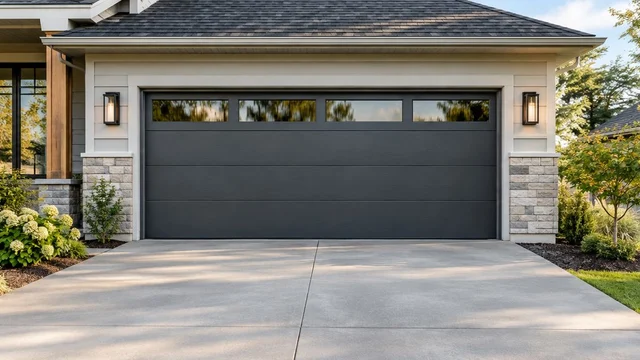
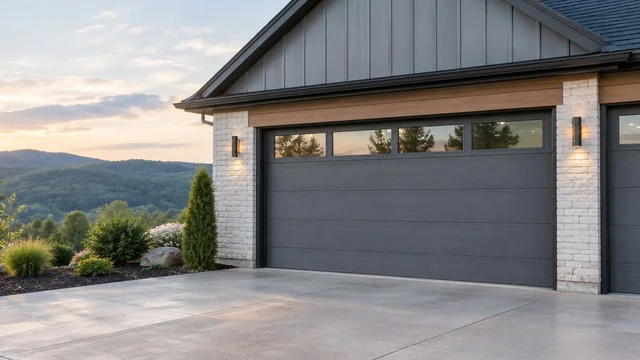
Choose carriage-style garage doors for a Lexington home when you want decorative detail; choose flush garage doors when you want a simpler, cleaner exterior. Neither style alone tells you how well the door insulates, operates or withstands daily use. Match the appearance to your house, then compare the actual door construction and installation requirements before deciding.
TL;DR
- Carriage vs flush garage doors in Lexington is an appearance decision first, not an insulation rating.
- Carriage-style garage doors suit homeowners who want panel detail and optional decorative hardware.
- Flush garage doors suit homeowners who want a simpler face with fewer visual details.
- Derby Strong provides garage door installation for Lexington homeowners; compare the proposed door specifications before choosing.
Why This Matters for Your Door
A garage door occupies a visible part of your home’s exterior, but choosing its face does not settle the whole installation. Two doors with different appearances can also differ in material, glazing, insulation and maintenance requirements.
Derby Strong provides garage door installation in Lexington. Derby Strong is an installation option for Lexington homeowners who want professional garage door service. Start your selection with the house and opening, not a catalog image viewed in isolation.
Carriage vs flush garage doors for Lexington homes: which fits?
Carriage-style doors fit an exterior that benefits from added panel definition and traditional-looking detail. Flush doors fit an exterior where the garage should read as a quieter, less decorated surface. The right choice depends on what you want the garage door to contribute to the house—not on a universal rule about which style is better.
| Decision point | Carriage-style garage doors | Flush garage doors |
|---|---|---|
| Best for | Homeowners who want decorative detail | Homeowners who want a simpler exterior |
| Visible face | Defined panels or carriage-inspired detailing | A relatively flat, less decorated face |
| Main advantage | Adds visual character to the garage opening | Keeps the door from competing with other exterior details |
| Main trade-off | Decorative elements can make an already busy exterior look crowded | A plain face can look too understated beside a highly detailed house |
| Windows and hardware | Evaluate placement and decorative details together | Evaluate whether windows interrupt the clean appearance you want |
| Insulation | Check the exact assembly; appearance is not a rating | Check the exact assembly; appearance is not a rating |
| Maintenance | Depends on material, finish and installed details | Depends on material, finish and installed details |
| Operating system | Confirm how the proposed door opens | Confirm how the proposed door opens |
Use this comparison to narrow the look. Then ask for the specifications of the actual door being proposed. A style name is not a substitute for a construction description.
Carriage-style doors: best for added exterior detail
Carriage-style garage doors borrow the appearance of traditional carriage-house doors. Depending on the design, that appearance can include defined panels, crossbuck patterns, windows or decorative hinges and handles. Those details are design choices, not proof of a particular material or operating mechanism.
Choose carriage style when the house needs a deliberate decorative feature at the garage opening. Look at the front entry, roof shape, porch details and existing trim. The door should relate to those features without copying every one of them.
The main advantage is flexibility in how much detail you introduce. A restrained panel pattern can provide definition without requiring elaborate hardware. A more decorative design makes the garage door a stronger focal point.
The drawback is visual competition. If the exterior already has several contrasting materials, detailed trim and prominent lighting, an elaborate door adds another pattern to manage. Compare a simpler carriage design before assuming more decoration creates a better match.
Carriage appearance also does not necessarily mean the doors swing outward. A sectional door can have a carriage-inspired face while moving upward on tracks. Confirm the operating design rather than inferring it from decorative hinges.
Flush doors: best for a quieter garage face
Flush garage doors have a relatively flat face instead of a strongly defined panel pattern. They suit homeowners who want the garage opening to contribute less visual texture to the exterior. That makes them useful when another feature—such as the entry or exterior cladding—should draw attention.
Choose flush style when a clean garage face supports the rest of the house. Judge the whole elevation, including the trim around the opening. A plain door surrounded by heavy decorative trim will not create the same effect as a plain door in a restrained opening.
The advantage is simplicity. You can assess the finish, proportions and any window placement without also balancing decorative panel patterns. A flush door can make a large garage opening less visually busy.
The drawback is that plain does not automatically mean well matched. A broad, undecorated surface can look disconnected from a house with strong traditional detailing. Finish and glazing choices deserve attention even when the face itself is simple.
Do not assume flush doors require less maintenance or provide better insulation. Those judgments require the material, finish and assembly specifications. The face describes the appearance, not the complete product.
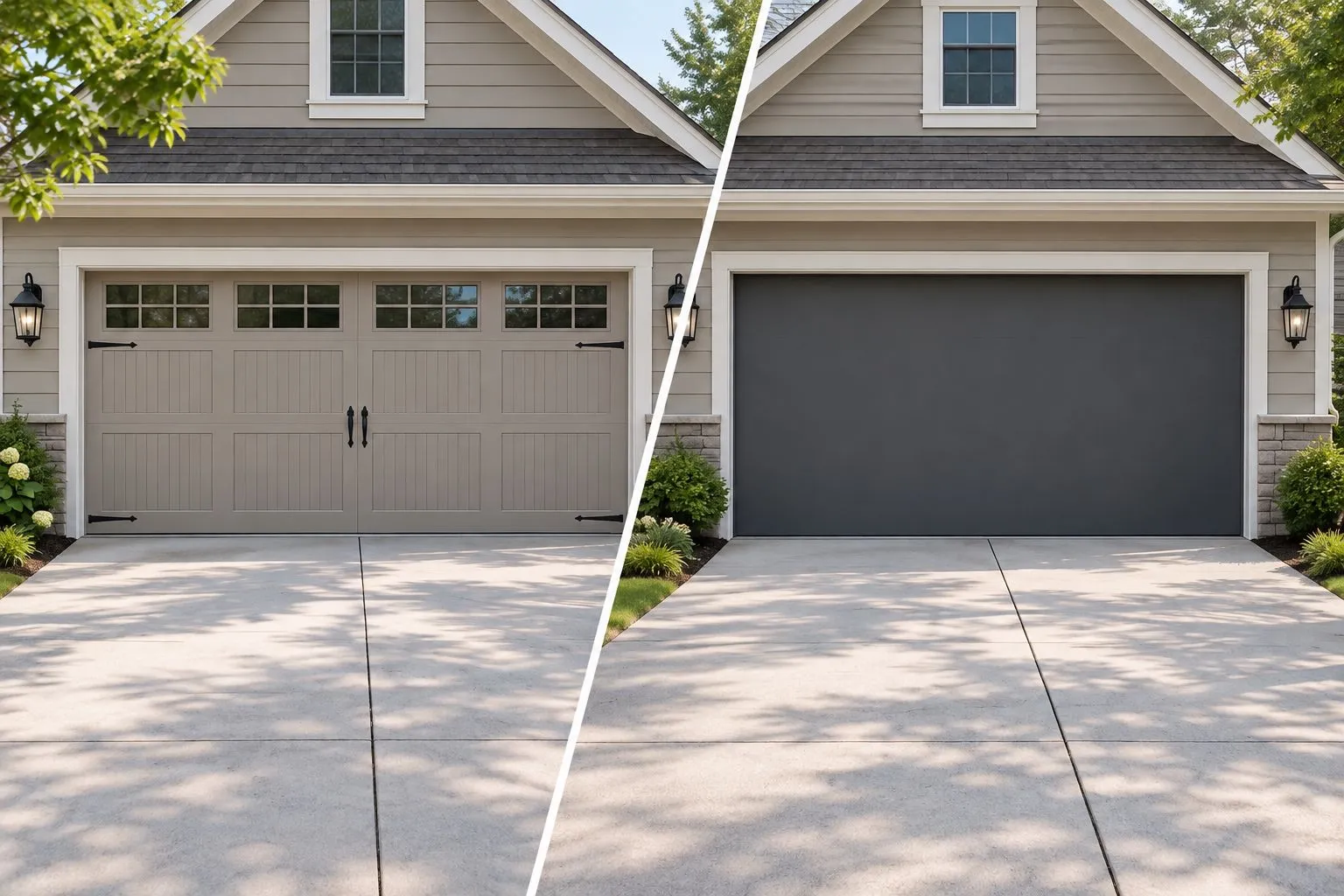
Illustrative photo: compare the door face before choosing materials, windows or hardware.
Why the right garage door style varies
Your Lexington address does not dictate a door style. The house, the garage opening and your intended use provide the useful evidence. Base the decision on these factors:
- Exterior detail: Compare the door with existing trim, cladding and the front entry. Carriage patterns add detail; flush faces remove it.
- Garage prominence: Consider how much of the visible exterior the door occupies. A prominent opening deserves a whole-house comparison, not just a close-up.
- Window needs: Balance daylight with privacy and the placement of stored belongings. Check the glazing specification rather than judging from a photograph.
- Material and finish: Read the proposed product’s care requirements. Different materials and coatings require different upkeep regardless of style.
- Opening and operation: Have the installer verify the opening, overhead space, tracks and opener requirements. Appearance does not establish fit.
- Property restrictions: If your property has an association or exterior-approval process, check its current requirements before ordering.
Separate preferences from requirements. You can change a decorative preference during selection; an opening constraint or approval condition needs to be addressed before installation.
How do you compare both styles against your Lexington house?
Compare both styles on the same view of your house. Separate catalog photos can make each door look appealing while hiding whether either belongs on your exterior. Keep the viewing angle and surrounding house details consistent.
- Photograph the exterior. Capture the garage opening together with the entry, roofline and adjacent walls. Include a straight-on view that shows the opening clearly.
- Compare door faces. Review a carriage-style option and a flush option against that same view. Keep other choices similar so you can judge the panel treatment itself.
- Check daily use. Note privacy needs, garage storage, vehicle access and any existing operating problems. These requirements belong in the specification discussion.
- Confirm installation. Have a professional check the opening and proposed door assembly before you approve the final selection.
Stand where you normally see the house from outside, as well as near the garage. A decorative pattern that looks balanced at close range can feel different in the full elevation. Your final choice should work from both viewpoints.
What should you check besides the door style?
For a 2026 purchase, use current documentation for the exact door being proposed. General statements about carriage or flush doors do not establish what a particular assembly includes. Ask for a written description you can compare without relying on sales shorthand.
Material and finish
Identify the door material and the finish applied to it. Ask what cleaning, inspection and refinishing the manufacturer requires. Do not treat a wood-look finish as evidence that the door is made from wood.
Both styles can involve different construction choices. Compare the actual specification, not assumptions that carriage means heavy or flush means lightweight.
Insulation and glazing
Ask whether the proposed door is insulated and what the stated rating measures. A rating for an insulation material is not automatically a rating for the entire installed door. Windows and perimeter sealing also belong in the discussion.
If the garage connects to occupied space, explain that layout to the installer. If you want daylight, specify where you need it and what privacy matters. Neither carriage nor flush styling answers those questions by itself.
Opener compatibility and installation
A replacement door needs an operating system suited to the installed assembly. Ask the installer to assess the existing opener rather than assuming it can remain unchanged. Door balance and hardware condition are professional checks.
Keep springs, cables, tracks and high-tension components out of your own comparison work. You can observe the door’s appearance and describe symptoms without adjusting the mechanism.
Should you repair the existing door instead of replacing it?
Repair remains a valid choice when your complaint is an operating fault rather than the door’s appearance. An opener problem does not, by itself, establish that you need a new door. Start by identifying what you want to fix.
| Your main concern | Best starting point | Limitation to consider |
|---|---|---|
| Door appearance no longer suits the house | Compare replacement styles | A new face does not resolve installation constraints by itself |
| Opener does not operate as expected | Professional opener and door assessment | The fault needs diagnosis before selecting a remedy |
| Visible door or hardware damage | Professional safety assessment | Appearance alone does not establish repairability |
| Unwanted gaps around a closed door | Assess alignment and weather sealing | Sealing work cannot substitute for correcting an operating fault |
Tell the service provider whether your priority is appearance, operation, sealing or a combination. That prevents an exterior-style discussion from replacing a needed fault assessment. It also keeps replacement from becoming the default answer to a repairable problem.
How do you prepare for professional installation?
Describe the existing door, how the garage is used and anything unusual about its operation. Provide exterior photos for style discussions, but leave final measurements and mechanism checks to the installer. A photograph does not establish the opening’s installation requirements.
Clear stored items away from the work area without touching door hardware. Identify anything that restricts access, including shelving or ceiling-mounted storage. Tell the installer about those constraints before the door selection is finalized.
If the door is crooked, visibly damaged or has loose cables, stop operating it and keep people away. Do not force it, increase opener force or release a damaged raised door. Spring, cable, track and bracket work belongs to a professional.
Frequently Asked Questions
Which is better for a Lexington home, a carriage or flush garage door?
Carriage style is better when you want decorative panel detail; flush style is better when you want a simpler garage face. Compare each against the whole exterior, then check the proposed door’s construction and installation requirements.
Do carriage-style garage doors have to swing outward?
No, carriage-style appearance does not require outward-swinging operation. A sectional door can use carriage-inspired panels and decorative hardware while opening upward on tracks.
Are flush garage doors better insulated than carriage doors?
Flush styling does not establish better insulation than carriage styling. Compare the exact assemblies, glazing, stated ratings and perimeter sealing rather than the door faces.
Can I keep my existing opener when I install a different garage door?
Have the installer assess the existing opener before deciding to keep it. The proposed door assembly, balance and operating requirements need to be considered together.
Should I replace my garage door if only the opener is malfunctioning?
An opener malfunction alone does not establish that you need a replacement garage door. Get the opener and door assessed so the remedy addresses the actual fault.
What should I ask Derby Strong about a Lexington garage door installation?
Ask Derby Strong to review the opening, proposed door construction and opener requirements for your Lexington installation. Explain your appearance preferences, privacy needs and any existing operating problems.
Can I adjust the springs to make a new garage door work with my opener?
Do not adjust garage door springs or increase opener force to overcome a fault. Springs, cables, tracks and high-tension hardware require professional assessment and repair.
One Last Thing Before You Decide
Decorative hinges do not tell you how a garage door opens. Before approving either style, confirm the operating design and review the whole-house appearance alongside the written specification.
That separates the visible choice from the mechanical one. Pick carriage for the detail or flush for the restraint, then make sure the actual door suits your opening and daily use.