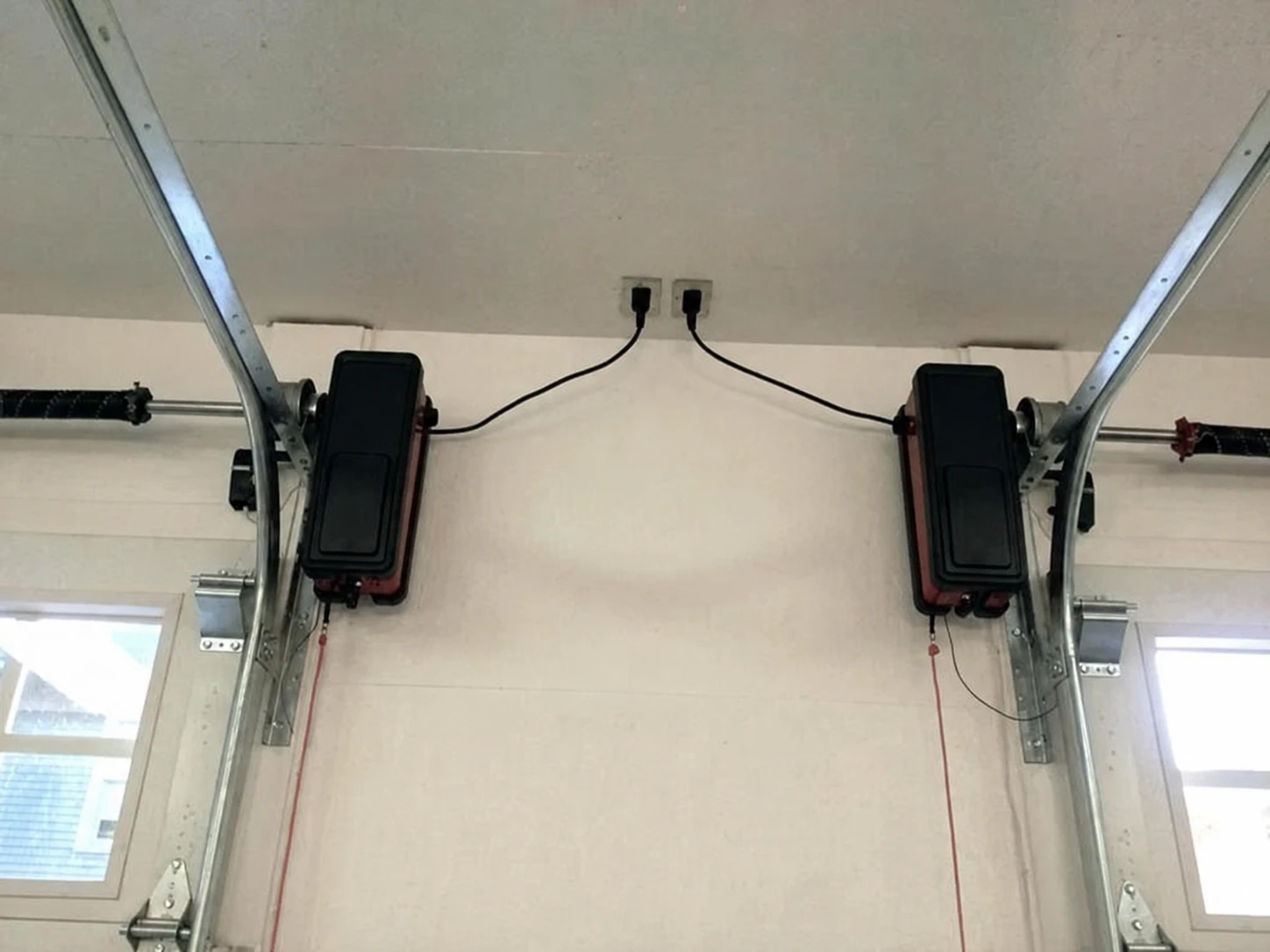
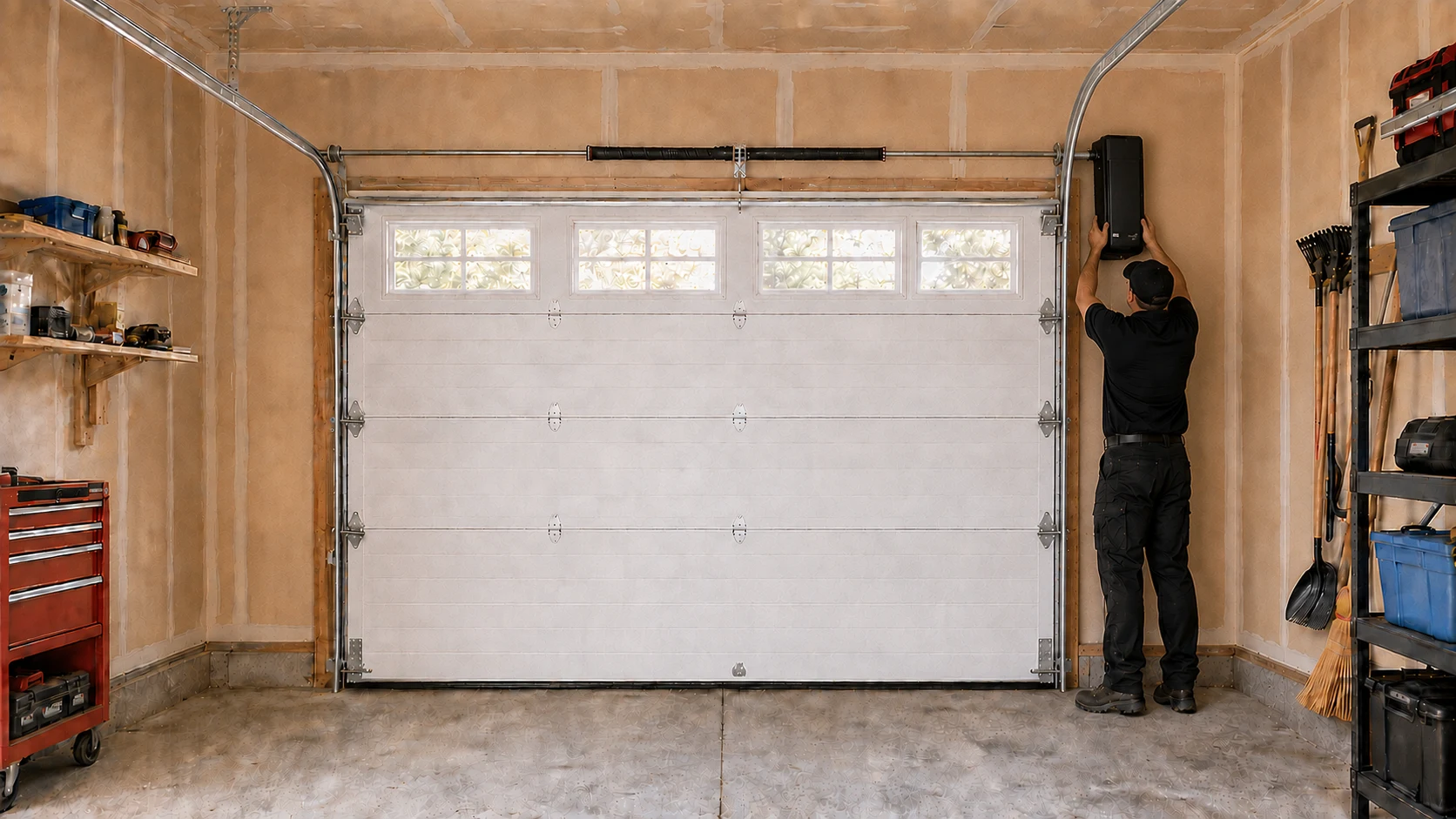
Technician installing a wall-mount opener beside a torsion shaft

Wall-Mount & Jackshaft Garage Door Openers: Southland, KY Services

Jackshaft garage door opener repair in Southland keeps older garages near Eastway Drive clear for ductwork, lights and storage. An older door on extension springs needs converting before a jackshaft can turn it.

Southland jackshafts keep older garage ceilings clear for storage.

Get Your Free Wall-Mount / Jackshaft Opener Quote

Repair, replacement, or fit consultation • No-obligation quote

Step 1 of 2
Required field
Required field
Required field

At a glance

Is Side Mount the Right Fit?

Depends on the door system
Drive arrangement
Turns the torsion shaftThe motor mounts beside the door rather than on a center rail.
Ceiling effect
Center ceiling stays openUseful for storage, lifts, lighting, and finished ceilings.
Strongest fit
Qualified torsion systemsNot every sectional door or shaft configuration qualifies.
Door geometry
Drums and track matterStandard, high-lift, and vertical-lift limits vary by model.
Safety hardware
Cable, lock, sensorsCable behavior and automatic-lock operation must be verified.
Available features
Battery, myQ, remote lightIncluded equipment varies by exact model.

How Side-Mount Openers Work

Understand the complete system

A wall-mount opener, often called a jackshaft or side-mount opener, attaches beside the door and turns the torsion shaft. It does not use the conventional center-ceiling rail and trolley, which preserves overhead space and reduces rail vibration.

The open ceiling is a benefit, not proof the door qualifies. Shaft size and condition, drums, cables, bearing support, track radius, high lift, side room, headroom, door dimensions, actual weight, balance, power, and model limits must be checked together.

Two side-mounted garage door openers beside separate torsion shafts
System viewSide-mounted operation that preserves the ceiling when the door system qualifies.
  1. 01

    Motor, collar, and torsion shaft

    The opener couples to the torsion shaft at the side of the door. Shaft extension, diameter, straightness, bearing support, coupler or collar security, and side clearance are fundamental.

    The opener couples to the torsion shaft beside the door.

  2. 02

    Drums, cables, tracks, and balance

    The opener rotates the same shaft that controls the drums and lift cables. Binding tracks, poor balance, damaged drums, or cable slack can create faults and unsafe travel.

    It turns the shaft that drives the drums and lift cables.

  3. 03

    Lock, light, controls, and sensors

    Current systems may use an automatic door lock, remote LED light, battery, myQ, travel module, wall control, remotes, keypad, and photo eyes. Each must be installed and tested as specified.

    Lock, light, battery, myQ and sensors are each tested.

Is Side Mount Right for Your Garage?

Strong fit when

  • Garages where overhead storage, a vehicle lift, specialty lighting, or a finished ceiling needs the center space.Garages that need the center ceiling for storage or a lift.
  • Cathedral ceilings and selected high-lift or specialty sectional-door configurations that fall within the exact model limits.Cathedral ceilings and qualifying high-lift doors.
  • Properly balanced sectional doors with compatible torsion shafts, drums, cables, track geometry, side room, and power.Balanced sectional doors with a compatible torsion system.
  • Homeowners who value a clean ceiling, battery backup, automatic locking, smart access, and remote lighting.A clean ceiling with battery, lock and smart access.

Choose another path when

  • The door uses extension springs or another lift system that does not meet the wall-mount manufacturer requirements.The door uses extension springs or another lift system.
  • The torsion shaft, drums, cables, bearing plates, track radius, side clearance, headroom, weight, or lift geometry falls outside the model limits.Shaft, drums, clearance or weight fall outside model limits.
  • A conventional belt drive provides the desired quiet operation with less compatibility complexity.A belt drive gives the quiet you want with less complexity.
  • The door is unbalanced, binding, crooked, off track, or experiencing cable problems that must be corrected before opener selection.The door is unbalanced, binding or has cable problems.

Jackshaft service guide

Explore Service Details

What We Check First on Every Visit

Garage and door compatibility

Residential wall-mount guides commonly publish strict dimensions and clearances, and heavy-duty models use different limits. The current installation manual for the exact opener always overrides a generic website summary.

01

Torsion shaft and bearing support

We verify the shaft diameter, condition, exposed length past the bearing plate, center and end bearing support, and a secure location for the drive collar.

Shaft diameter, condition, length and bearing support.

02

Drums, cables, and door balance

Drum diameter, cable routing, cable tension, door weight, spring balance, and smooth manual travel must suit the model and remain stable through the full cycle.

Drums, cables, weight and balance must suit the model.

03

Track geometry and lift type

Standard lift, high lift, vertical lift, track radius, top-fixture travel, door height, width, and open-door position must fall within the exact installation instructions.

Lift type, track radius and door size must fit the manual.

04

Side room and headroom

The motor, collar, cable system, bearing plate, automatic lock, and service access require model-specific clearance beside and above the door.

The motor, collar and lock need clearance beside the door.

05

Power, light, lock, and controls

Outlet location, remote-light placement, automatic-lock location, sensor wiring, wall control, keypad, remotes, myQ signal, and battery access are planned before mounting.

Outlet, light, lock, sensors and controls are planned first.

06

Door construction and use

Actual door weight and lift geometry matter more than the number of bays. Heavy, tall, or specialty doors may require a different wall-mount model or another solution.

Actual door weight and lift geometry decide the model.

Compatibility notes

Parts are matched to the exact model.

  • A properly balanced sectional door and compatible torsion system are fundamental requirements.A balanced sectional door and torsion system are required.
  • Published residential limits may include shaft, drum, clearance, door-area, width, height, high-lift, radius, and weight restrictions.Models publish shaft, drum, size and weight limits.
  • The 98022 and 98032 are different applications; a heavy-duty model is not automatically interchangeable with a standard residential wall mount.The 98022 and 98032 are not interchangeable applications.
  • Cable tension, drum condition, track travel, and spring balance should be corrected before opener-side adjustments.Door-side cable and balance issues are fixed first.
  • Battery operation does not guarantee internet, myQ, or video access if the garage network is offline.Battery backup does not keep internet or myQ online.

Compare Opener Types

ComparisonWall-Mount / Jackshaft OpenerOther system
Versus belt driveClears the center ceiling and eliminates the conventional trolley rail.Belt fits more conventional layouts and is often the simpler quiet choice for attached garages.
Versus chain driveCleaner ceiling and less rail vibration when the torsion system qualifies.Chain works with many standard center-rail layouts and is often more value focused.
Versus legacy screw driveCurrent smart, battery, lock, and remote-light options with compatibility-led installation.An existing legacy opener may still be worth an isolated repair if it remains safe and supported.

Side-Mount Opener Models to Compare

Manufacturer examples

Compare the current LiftMaster 98022 and 98032 with the Chamberlain RJO101. Each serves a different qualified application, so the exact door, shaft, track, weight, and included equipment still matter.

LiftMaster garage door opener brand logo

We primarily install and service LiftMaster and Chamberlain. LiftMaster is the professional line; Chamberlain is the retail line. We also support other major brands when compatible parts are available.

LiftMaster

Residential wall mount

98022

A current professional wall-mount model for qualifying residential sectional doors with compatible torsion hardware and geometry.

  • Battery backup and myQ
  • Remote 1,000-lumen LED lighting
  • Automatic garage door lock
View official specifications
LiftMaster

Heavy-duty wall mount

98032

A heavy-duty professional model for qualifying residential doors within its published weight, lift, drum, shaft, and track limits.

  • 400–1,100 lb published application range
  • Battery backup and myQ
  • Remote LED light and automatic lock
View official specifications
Chamberlain

Residential wall mount

RJO101

Chamberlain’s current retail wall-mount model for compatible torsion-shaft residential doors and open-ceiling layouts.

  • DC direct-drive operation
  • Battery backup and myQ
  • Remote LED lighting and automatic lock
View official specifications

These are the current residential side-mount models published by LiftMaster and Chamberlain. Earlier 8500, 8500W, RJO20, and RJO70 systems remain model-specific service cases. The exact manual controls shaft, drum, lift, track, clearance, door-area, and weight limits.

Open center ceiling for qualifying garages with storage, lifts, lighting, or finished-ceiling priorities.

Open center ceiling for storage, lifts or lighting.

Battery backup and myQ connectivity on current example models.

Automatic door lock and remote LED-light solutions on selected supported systems.

Standard residential and heavy-duty platforms for materially different qualified applications.

Standard and heavy-duty models for different doors.

Selection and upgrade notes

  • Current systems may combine battery backup, myQ, remote lighting, automatic locking, keypad, remotes, and smart-access functions.Battery, myQ, lighting, locking and smart access options.
  • A high-lift conversion and wall-mount installation are separate design decisions that require door, track, spring, drum, and opener engineering.High-lift conversion is a separate engineering decision.
  • Belt drive can be the better attached-garage choice when quiet operation matters but open ceiling space is not required.A belt drive may fit if you don’t need open ceiling space.

Common Problems We Diagnose

Repair starts with diagnosis

Similar symptoms can come from the opener or the door. We find the actual fault before recommending parts.

01

Travel or position faults

Travel modules, controls, door balance, obstructions, track geometry, or inconsistent shaft movement can stop the system or produce diagnostic codes.

Travel, balance or track issues can stop the opener.

02

Lock or remote-light errors

The automatic lock, remote light, wiring, programming, battery, wall control, or accessory compatibility can fail while the motor remains serviceable.

Lock, light, wiring or battery can fail on their own.

03

Collar, coupler, or shaft movement

Loose or worn connection hardware can let the motor run without transferring correct motion to the torsion shaft.

Worn connection hardware can stop the shaft turning.

04

Cable slack or drum trouble

A binding door, balance problem, damaged drum, cable issue, or track condition can let a cable lose tension. That is a door-system fault, not simply a motor setting.

Slack cables point to a door-system fault, not a setting.

05

Sensors and controls

Photo-eye alignment, wiring, wall controls, remotes, keypads, myQ setup, network signal, logic boards, and batteries can create intermittent operation.

Sensors, controls or batteries can act up intermittently.

06

An unqualified installation

Insufficient side room, incorrect shaft or drums, incompatible track geometry, door weight outside limits, or poor mounting can cause repeat faults and unsafe travel.

Poor fit or mounting causes repeat faults and unsafe travel.

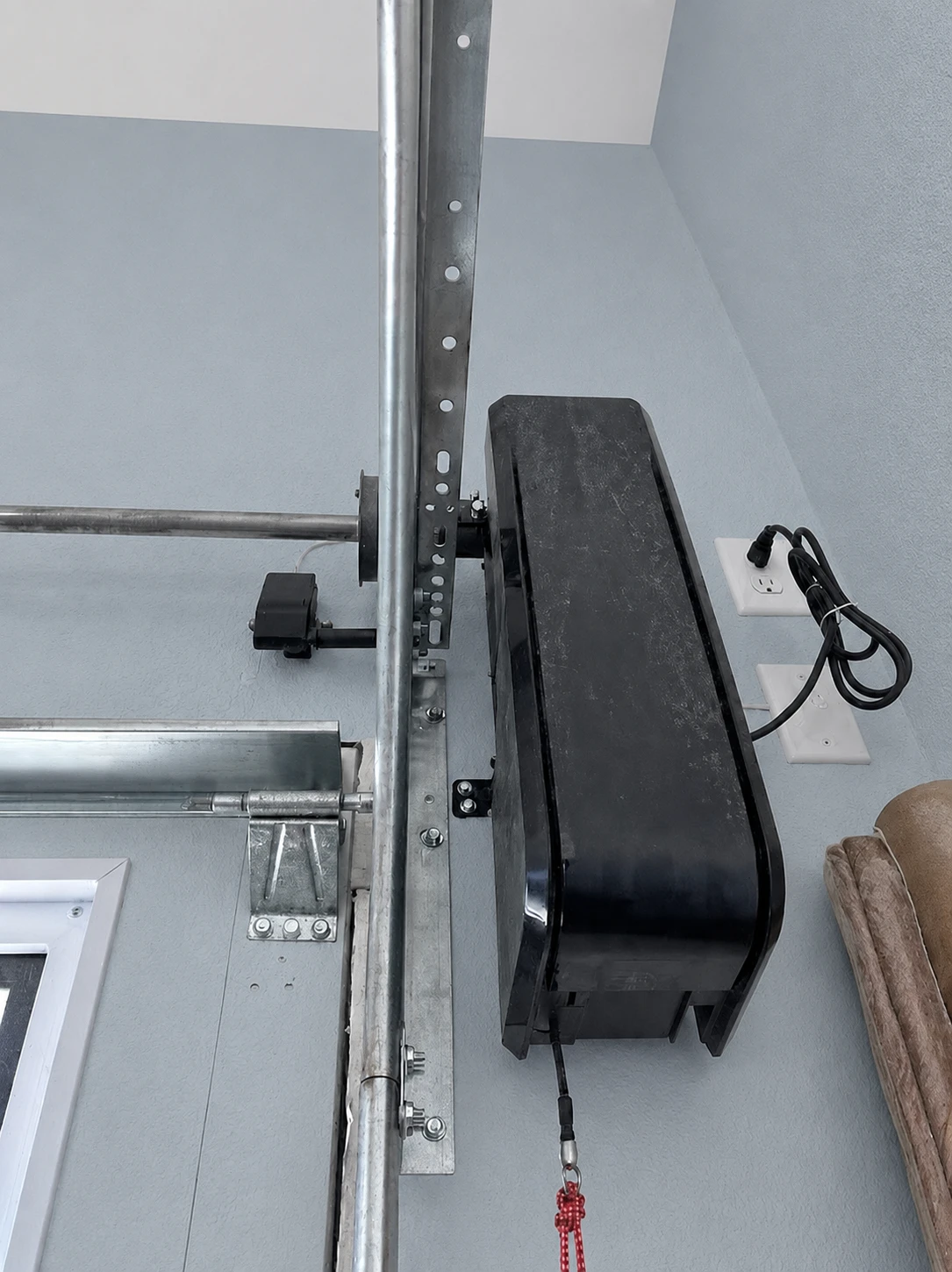
Side-mounted opener beside a torsion shaft against a blue-gray wall
Stop cycling the openerwhen the door is crooked, unusually heavy, binding, dropping, off track, or supported by damaged springs or cables.

Common symptoms worth scheduling

  • The motor or torsion shaft moves but the door does not travel correctly.
  • A cable becomes slack, leaves a drum, or changes tension during travel.
  • The automatic lock, remote light, battery, sensors, or controls show errors.
  • The opener clicks, vibrates, stops, reverses, or repeatedly loses position.
  • The door moves unevenly, binds, or is difficult to operate by hand.
  • The garage layout or door hardware has changed since the opener was installed.

Repair or Replace? How We Help You Decide

Repair is often sensible when

  • The door and torsion system still qualify, remain balanced, and the issue is isolated to a supported opener-side component.The door still qualifies and one opener part failed.
  • The travel module, lock, remote light, control, sensor, battery, network setup, collar, or compatible board can be restored.The module, lock, light, controls or collar can be restored.
  • Drums, cables, tracks, shaft, bearings, springs, and mounting remain sound or can be corrected safely.Drums, cables, tracks and springs are sound or fixable.
  • The system passes the exact manufacturer safety and travel tests after repair.It passes the manufacturer’s safety and travel tests.

Replacement is often stronger when

  • The opener is outside the door weight, size, lift, drum, shaft, track, or clearance limits.The door is outside the opener’s weight or size limits.
  • Critical parts are obsolete, major failures overlap, or repeated faults show poor system compatibility.Parts are obsolete or faults keep recurring.
  • The torsion system or garage layout requires a different wall-mount model or a conventional belt or chain solution.The door needs a different wall mount or a belt or chain.
  • Required safety devices, lock behavior, cable control, or reversal performance cannot be restored correctly.Safety, lock or reversal behavior can’t be restored.

A loose cable, damaged drum, poor balance, or binding door must be corrected before blaming the wall-mount opener. Replacing the motor alone will not repair the counterbalance and track system it depends on.

What to Expect From Service

Professional service

Derby Strong treats wall-mount installation as a compatibility assessment, not a premium upgrade that fits every door. We measure the complete torsion and track system before recommending equipment.

We primarily work with LiftMaster and Chamberlain systems and can distinguish opener-side failures from drums, cables, springs, bearings, tracks, and balance problems that must be repaired first.

Four service steps

  1. 01

    Measure and inspect the torsion shaft, bearings, drums, cables, springs, track geometry, lift type, clearances, door dimensions, actual weight, balance, power, and mounting surface.

    Inspect the shaft, drums, cables, springs and door balance.

  2. 02

    Diagnose opener-side controls, travel, collar, lock, light, battery, sensors, network, and electronics separately from door-system faults.

    Diagnose opener faults separately from door-system faults.

  3. 03

    Repair the supported component or install the exact qualified wall-mount opener, lock, light, controls, safety devices, and selected accessories.

    Repair the part or install the qualified wall-mount system.

  4. 04

    Cycle-test cable behavior, travel, lock timing, photo eyes, contact reversal, manual release, battery operation, remotes, keypad, light, and myQ as equipped.

    Cycle-test cables, lock, sensors, reversal and controls.

Ownership guide

Watch cable behavior

If a cable becomes slack or begins leaving a drum, stop cycling the door. Do not try to guide the cable by hand or continue using the opener.

If a cable goes slack, stop using the door and opener.

Keep the door mechanically healthy

Wall mount relies heavily on smooth tracks, stable drums, correct spring balance, sound bearings, and predictable cable tension through the entire cycle.

Wall mounts depend on smooth tracks, drums and balance.

Test the complete safety system

Check photo eyes and contact reversal monthly. Confirm the automatic lock releases and engages correctly, and inspect battery status as the model directs.

Test photo eyes, reversal and the lock monthly.

Protect service clearances

Do not place storage, wiring, shelves, or finishes where they block the opener, shaft, lock, light, outlet, sensors, or future technician access.

Keep storage and wiring clear of the opener and shaft.

Customer reviews

Kentucky homeowners recommend Derby Strong.

Wall-mount jackshaft opener repair across Southland

Stratford Drive came in as its own stage of the Southland subdivision, laid out apart from its neighbors. Most garages near Eastway Drive and the Oleika Shrine Temple belong to older houses. In an older garage, the space above the door may already hold ductwork, lights or storage. A wall-mounted jackshaft opener keeps that ceiling clear, provided the door has torsion springs and room on the side wall.

Jackshaft openers attach to the end of the torsion shaft and rotate it from the side wall. On an older door still using extension springs, the spring system would need converting first. Once a jackshaft is in service, most failures involve the motor board, the cable tension sensor or the wall control. Balance still matters. The springs must carry the door's weight, since the opener only turns the shaft. We check that balance on every visit.

Service area coverage

Local ZIP: 40503

Open in Google Maps

Side-Mount Questions

01Who do I call to repair or install a jackshaft opener in Southland?

Call Derby Strong. We repair and install wall mount openers on doors that qualify for one. Before recommending one, we look at three things: the cable drums, the side clearance and the shaft. That matters because the motor turns the torsion spring shaft directly. If your door is not right for a wall mount model, the usual choice is a chain or belt opener on the ceiling.

02Is my garage door compatible with a wall mount opener?

A wall mount opener fits many sectional doors that have a torsion spring on a shaft over the door. Several things have to line up. The shaft, drums and track need to suit the model, and the motor needs enough wall space next to the door. The opener's limits also have to cover the door's height, weight and balance.

03Are wall mount garage door openers made for extension springs?

A standard residential wall mount opener needs a torsion spring system. It is not made for extension springs, the ones running along the side tracks. Replacing extension springs with a torsion system is separate work. The full lift system gets inspected first, and then we recommend a path.

04How much room do I need next to the door for a jackshaft opener?

It varies with the model. The motor is mounted on the end of the torsion shaft, next to the door. That side wall has to fit the motor and the cable drum, and still leave room to service them. Manufacturers list the exact measurements. Before approving the layout, we take measurements in your garage and compare them with the current manual.

05Is a wall mount opener an option with a car lift or a high garage ceiling?

Often. A wall mount opener is mainly chosen to leave the middle of the ceiling open. The space is then free for a car lift, for storage or for a finished ceiling. High lift and vertical lift doors can be supported, but only by selected models. Each model has its own limits, and the door's height, weight and track must fit within the exact manual.

06Why has a cable gone slack on my wall mount opener door?

In most cases, a loose cable comes from a door that binds, has lost its balance or travels unevenly. A drum or track problem can also cause it. Keep clear and stop operating the door, because the slack cable may come off its drum. Before any adjustment is made to the opener, the balance, springs, cable and drum should be inspected.

07Does a wall mount opener run quieter than a belt drive?

Sometimes. With no rail or trolley running across the ceiling, a wall mount opener passes less vibration into the rooms above the garage. Belt drives are very quiet as well, and they fit more garages. With either type, worn rollers and worn hinges, or a door that is unbalanced, will make more noise than the opener does.

08What is repairable on a wall mount jackshaft opener?

A good number of parts, depending on which model you have. Frequent repairs are to the battery backup, automatic lock, sensors, controls and remote light. Cable, drum, spring and shaft problems belong to the door, not the opener, and are handled as door work. Door work comes before any adjustment to the opener, so everything in the system runs safely.

Local opener help

Tell us what the opener and door are doing.

Share the brand, model, symptoms, and any features you want if replacement is being considered.

Derby Strong provides wall-mount and jackshaft opener qualification, repair, and installation across Louisville, Lexington, Northern Kentucky, and nearby communities. Specialty-system scheduling and model availability are confirmed for the service address.

  • Repair and replacement options
  • LiftMaster and Chamberlain focus
  • Many major brands serviced
Call (859) 436-2954

Request Wall-Mount / Jackshaft Opener Service

Serving Southland and nearby Lexington communities. Share the essentials and we’ll call to confirm the right service timing.

Step 1 of 2
Required field
Required field
Required field

Derby Strong Garage Doors

Garage door trouble?

Talk to our local team now about a broken spring, a stuck door, an opener or a new door.

Call (859) 436-2954 Schedule online

5.0 from 298 reviews